
The institute
FEMTO's news

Dissociating Nitrogen Molecules Using Silicon Atoms

Researchers from FEMTO-ST have just demonstrated a novel process for dissociating nitrogen molecules through low-energy footprint processes, a crucial step towards the decarbonized production of high-value-added molecules.

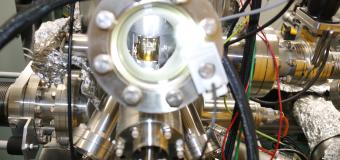
The industrial synthesis of ammonia from nitrogen molecules represents 2% of global energy consumption because this synthesis requires very high pressures and temperatures (200 atmospheres, 600°C). The development of energy-efficient processes for the dissociation of nitrogen molecules is a major challenge for the ecological transition. To develop these types of processes, it is essential to understand the elementary mechanisms that cause the dissociation of these nitrogen molecules. As part of the OVATION project, funded by the National Research Agency, ChimieParisTech and FEMTO-ST have demonstrated that silicon atoms have the ability to dissociate these nitrogen molecules at room temperature and under very low pressures (<1 atmosphere). This result was obtained using a scanning tunneling microscope (STM, link to previous news if possible), which allows the study of the modification of the electronic properties of silicon atoms when exposed to nitrogen molecules.

By adjusting the experimental conditions, the researchers demonstrated that silicon atoms could transfer electrons to nitrogen molecules and thus cause their dissociation. This process is efficient and requires little energy.

After successfully demonstrating a new type of nitrogen molecule dissociation, the second step is to form the ammonia molecule. This requires reacting hydrogen molecules inside the STM microscope, a new scientific challenge for the members of FEMTO-ST's nanosciences group.

Contacts :
Prof. Dr Frank PALMINO
Dr. Fréderic CHERIOUX

This article is highlighted as the cover picture of  ChemPhysChem : https://chemistry-europe.onlinelibrary.wiley.com/doi/full/10.1002/cphc.202300458

[[{"fid":"23176","view_mode":"default","fields":{"format":"default","alignment":"","field_file_image_alt_text[und][0][value]":false,"field_file_image_title_text[und][0][value]":false,"external_url":""},"type":"media","field_deltas":{"1":{"format":"default","alignment":"","field_file_image_alt_text[und][0][value]":false,"field_file_image_title_text[und][0][value]":false,"external_url":""}},"attributes":{"class":"media-element file-default","data-delta":"1"}}]]
 

  • Electronique moléculaire : un nouveau regard sur l’organisation des molécules ioniques

    Des scientifiques de l’Institut de chimie de Strasbourg et de FEMTO-ST ont développé une méthode innovante permettant d’améliorer la caractérisation des interfaces ioniques à l’échelle nanométrique, et ainsi d’analyser de nouveaux matériaux pressentis pour s’insérer dans la prochaine génération d

    Read more
  • Ondes de spin optiques, un nouvel état de la lumière

    Les états magnétiques présents dans la matière sont une source d’inspiration pour imaginer de nouveaux états de la lumière. Une équipe de l’institut FEMTO-ST a conçu puis créé un équivalent optique des ondes dites « de spin » se propageant dans les aimants.

    Read more
  • FEMTO-ST celebrates its 20th anniversary

    Surrounded by its co-supervisors and partners, the FEMTO-ST institute celebrated its 20th anniversary on Wednesday 26 June in Besançon.

    Read more
  • Eric MAZUR (Harvard Université) en conférence à FEMTO-ST

    Professeur à l'Université de Harvard, ce scientifique de renommée internationale dans le domaine des  interactions ultrarapides entre la lumière et la matière et la science des matériaux  est intervenu dans nos locaux ce vendredi 21 Juin.

    Read more
  • John Dudley appointed senior member of the institut universitaire de France

    A member of FEMTO-ST's Optics Department and professor at the University of Franche-Comté, John Dudley has been appointed to a Fundamental Chair in senior category of the Institut Universitaire de France

    Read more
  • Développement d'un polymère thermodurcissable biosourcé et recyclable :

    Une étape majeure vers l'intégration des composites à matrices thermodurcissables dans l'économie circulaire et biosourcée.

    Read more
  • FEMTO-ST s'implique du 13 au 15 Mai à Pint of Science Festival

    De nombreux chercheurs de l’institut se mobilisent à Besançon à l’occasion de la 11ème édition du festival international de vulgarisation scientifique sur des thématiques variées : optique, robotique, microtechniques pour les médicaments innovants, développement durable.

    Read more
  • Laser nanofabrication: nanopillars emerging from sapphire

    Femtosecond lasers are well known for their ability to cut materials with extreme precision and texture surfaces. A FEMTO-ST team has achieved a world first, opening up a new use for these lasers.

    Read more
  • Best paper award on BIOSEC 2024

    Raniya Ketfi, Zeina Al Masry, and Noureddine Zerhouni have been awarded the Best Paper Prize at the 17th International Joint Conference on Biomedical Engineering Systems and Technologies

    Read more
  • Mayra Yucely Beb Caal awarded "Female Science Talents Intensive Track Champion 2024"

    A PhD student in FEMTO-ST's micro and nanorobotics team, she is one of 20 talented women from 15 countries, each making a significant contribution in their scientific field.

    Read more