
The institute
FEMTO's news

Optical Neural Networks start to learn...

Work is actively in progress at FEMTO-ST in order to design the photonic architectures dedicated to our future processors that will be computing through artificial intelligence concepts. This is currently done in the framework of the NeuroQNet Project which led recently to an important result in photonic brain-inspired computing: an experimental training methodology based on reinforcement learning was successfully demonstrated.The setup has involved an optical Read-Out of a photonic neural network, in the form of a matrix of micro-mirrors. It succeeded in training iteratively, and efficiently, the Read-Out for the prediction of a chaotic behavior, which was computed from a photonic network processor of 900 «light-neurons». Extrapolating this approach to more practical and highly complex problems, this could lead to ultra-fast and highly efficient weather forecast, without any numerical simulation of complicated equations modeling the atmosphere. This would simply need to learn the weather motions from the observation of past weather dynamics.

Similar groundbreaking brain-inspired processing concepts are also explored at FEMTO-ST in the framework of a very practical and concrete application: the diagnostic and prognostic of fuel-cell systems, in order to increase the lifetime of this clean electrical energy generator for the future (BiPhoProc project from the ANR call OH-RISQUE; a project jointly explored by the Energy Dept. at FEMTO-ST, as well as by the Mathematics laboratory of Besançon)

Research in this field at FEMTO-ST stands at the international forefront, as illustrated by a prestige conference to be held in Hanover, Germany, on 18-20 December 2018. The conference inviting some the best researchers worldwide (Standford, Berkeley, EPFL,...) on basic concepts for cognitive computing « Cognitive Computing: Merging Concepts with Hardware ») is co-organized by FEMTO-ST (Dr Daniel Brunner)


The publication on learning with photonic networks, published in  Optica, was moreover chosen for the issue cover by the editorial board, because of its high potential impact

Contact : Daniel Brunner,  OPTO Group, Optics Dept
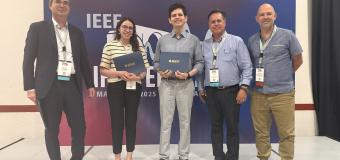
  • Two FEMTO-ST PhD students win awards at the IFCS-EFTF 2025 international conference

    Their innovative work paves the way for new environmental monitoring devices and a new generation of atomic micro-clocks.

    Read more
  • 3 tenure track position at FEMTO-ST

    In 3 of its strategic research priorities: micro-nanotechnologies, artificial intelligence and sustainable development.

    Read more
  • FEMTO-ST s'implique du 19 au 21 Mai à Pint of Science Festival

    De nombreux chercheurs de l’institut se mobilisent à Besançon et à Belfort  à l’occasion de la 11ème édition du festival international de vulgarisation scientifique sur des thématiques variées : optique, robotique, IA... Inscrivez-vous pour

    Read more
  • FEMTO-ST is launching its support program for MSCA Postdoctoral Fellowships applications !

    The Boostcamp is a two-day intensive workshop aimed at helping international researchers develop a strong application for the 2025 Marie Skłodowska-Curie Postdoctoral Fellowship.

    Read more
  • Using artificial intelligence to collect agricultural data

    ANR OCOD project combines intelligent sensors, drones and optimization for data collection in constrained natural environments

    Read more
  • A European project to prevent perineal tears

    PELVITRACK offers a predictive tool for patricians as part of an interdisciplinary European consortium involving FEMTO-ST.

    Read more
  • 12 postes d’enseignants-chercheurs à pourvoir à FEMTO-ST

    Informatique, Génie informatique - automatique et traitement du signal, Génie Civil - Physique et Energétique du bâtiment, mécanique – génie mécanique.

    Read more
  • Best Paper Award at BIOSTEC 2025

    The work of Ouassim Boukhennoufa and his team combines AI and image optimization in nuclear medicine for more accurate and earlier detection of parathyroid anomalies.

    Read more
  • Kagomé structures for quantum technologies

    Quantum technologies open up promising prospects, but require the development of new materials with remarkable properties.

    Read more
  • Launch of the European SAMI project for energy-free intelligent sensors

    A major scientific and technological collaboration between Silmach and FEMTO-ST in the field of intelligent, autonomous sensors kicks off on January 30.

    Read more