
The institute
FEMTO's news

Vincent Laude reçoit le prix IEEE Carl Hellmuth Hertz 2016

Le IEEE Carl Ellmuth Hertz Ultrasonics Award est un prix international décerné annuellement par
la société Ultrasonics, Ferroelectrics, and Frequency Control (IEEE/UFFC). Il récompense un
chercheur de 10 à 25 ans d’expérience dont les travaux ont été effectués dans le domaine de la
physique des ondes ultrasonores. Il est sélectionné par un jury international, le Ultrasonics Award
Committee, et remis chaque année lors du congrès international IEEE Ultrasonics Symposium.

V. Laude

V. Laude

Remise prix

Remise prix

Remise prix

V. Laude

“For substantial contributions to the physics of phononic crystals and of the interaction of sound and light”
La citation accompagnant la récompense remise à Vincent Laude fait état de ses « contributions
substantielles à la physique des cristaux phononiques et des interactions entre son et lumière ». Le
prix a été remis à Tours, le 19 septembre 2016, lors de la cérémonie d’inauguration du congrès
IEEE Ultrasonics Symposium 2016.
Vincent Laude est directeur de recherche au CNRS et membre du département Micro Nano
Sciences et Systèmes (MN2S) de l’Institut FEMTO-ST. Ses activités de recherche concernent la
propagation des ondes élastiques et acoustiques dans les micro et nano structures, en particulier
dans les cristaux phononiques. Ces matériaux périodiques artificiels trouvent des applications pour
l’isolation sonore, la protection contre les vibrations ou encore la téléphonie mobile. Il s'intéresse
également aux interactions entre son et lumière dans les nanostructures. Il est l’auteur du livre
« Phononic crystals: Artificial Crystals for Sonic, Acoustic, and Elastic Waves » paru chez
Degruyter en 2015 et a publié plus de 120 articles dans des revues internationales à comité de
lecture. Il a dirigé le département Micro Nano Sciences et Systèmes de FEMTO-ST de 2006 à 2009,
dont il est aujourd’hui directeur adjoint. Il exerce des fonctions d’animation scientifique au sein du
laboratoire d’excellence Action et du GDR Ondes.

Document en pdf (pdf, 176 Ko)

  • « Micron d’or » Award at the international microtechnology trade fair

    For one of the most dexterous miniature robots with 7 degrees of freedom, allowing micromanipulation and microassembly in extremely confined spaces

    Read more
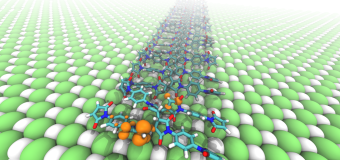
  • Polymer-based nanowires

    Molecules, salt and light :  an easy recipe to provide giant nanowires !

    Read more
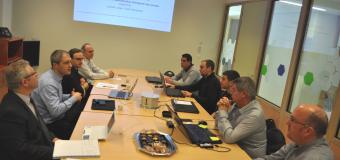
  • Discussions about good practices around smart specialization

    In the frame of the 2014-2020 programming of the European Regional Development Funds (ERDF), the European Union has asked all the regions of Europe to draw up a "Smart Specialization Strategy" for research and innovation on their own territory: this is the S3.

    Read more
  • Optical Neural Networks start to learn...

    Work is actively in progress at FEMTO-ST in order to design the photonic architectures dedicated to our future processors that will be computing through artificial intelligence concepts.

    Read more
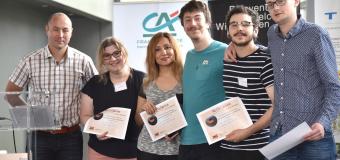
  • FEMTO-ST remporte le 2e prix d'ActInSpace 2018 (Besançon)

    La troisième édition d'ActInSpace s’est déroulée en simultané dans plusieurs villes de France, d'Europe et du monde les 25 et 26 mai 2018.

    Read more
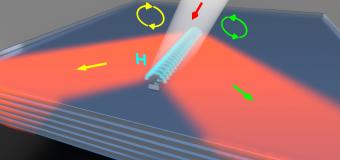
  • When the light is directed by its magnetic field

    FEMTO-ST researchers have discovered a new optical magnetic interaction to direct light fluxes. These works are published in the journal Light: Science and Applications
    Read more
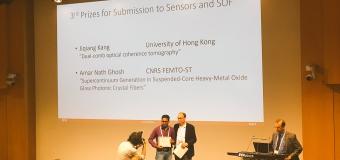
  • Amar Nath Ghosh awarded at OSA Advanced Photonics Congress

    Amar Nath Ghosh won the Best student paper award of the OSA Advanced Photonics Congress , Zurich.

    Read more
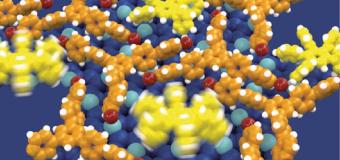
  • L'équipe nanoscience de FEMTO-ST en couverture du journal de la société chimique de France

    Read more
  • Focus on the innovations of the "hydrogen-energy systems" sector

    A few days after the announcement by the government of the launch of a major national hydrogen plan, the Femto-ST institute is organizing on 20 June 2018 at the FCLAB in Belfort, a focus on innovations in the "hydrogen energy systems" sector.

    Read more
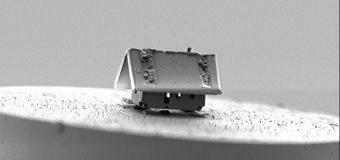
  • Robotic assembly of the smallest house in the world

    the handling and assembly capabilities of nanocomponents of the "μRobotex" platform make the buzz on the net and in the international press through the origami manufacturing of a micro-house at the end of an optical fiber whose dimensions are less than the diameter of a hair.

    Read more