
The institute
FEMTO's news

Abdelkrim Khelif reçoit une médaille de bronze CNRS 2007

Abdelkrim Khelif est le lauréat 2007 de la section 8 du CNRS. Suivant la formule officielle, "La médaille de bronze récompense le premier travail d'un chercheur, qui fait de lui un spécialiste de talent dans son domaine. Cette récompense représente un encouragement du CNRS à poursuivre des recherches bien engagées et déjà fécondes."

Guide phononique coudé

Guide phononique coudé

Guide phononique coudé

Abdelkrim Khelif a été recruté au CNRS en 2002, en qualité de chargé de recherche. Ses travaux portent sur les cristaux phononiques, des matériaux structurés périodiquement qui présentent des propriétés acoustiques extraordinaires, notamment des bandes interdites complètes (des régions du spectre dans lesquelles toute propagation d'onde est interdite quelle que soit la polarisation ou la direction).

Voir le site du CNRS et plus précisément un portrait de A. Khelif écrit à cette occasion.

médaille

médaille

médaille

Abdelkrim Khelif

Abdelkrim Khelif

Abdelkrim Khelif

Entouré de nombreux amis, collègues, représentants de divers organismes et personnalités régionales, Abdelkrim Khelif a reçu le 9 juin 2008 dans le grand salon du Conseil Régional de Franche Comté, en la présence de sa Présidente, la médaille de bronze CNRS qui lui a été remise par le délégué régional centre-est et le directeur scientifique adjoint du département des sciences et technologies de l'information et de l'ingénierie du CNRS.
  • FEMTO-ST is closed

    Within the framework of Coronavirus (COVID-19) epidemic and  following the measures announced by the President of the French Republic,  all the premises of our laboratory in Besançon, Belfort and Montbéliard cities are closed to the public from this Tuesday March 17.

    Read more
  • I-PhD Innovation Competition: 2 winners from FEMTO-ST

    Maya Geagea (ANIO-PAC project: micro fuel cells), and Gaël Matten (VIBISCUS project: noise reduction system), special jury prize, are winners of the 2019 innovation awards.

    Read more
  • Sarah Benchabane winner of an ERC Consolidator grant 2019

    CNRS Research Fellow at the FEMTO-ST Institute, Sarah is awarded with a prestigious €2M European Research Council (ERC) grant for her  project : Nanophonics for Quantum Information Processing.

    Read more
  • Stardust Odyssey : A new world record !

    Discover the smallest volume character ever animated in stop-motion (frame by frame) through a short film made thanks to FEMTO-ST's high-tech robotic equipments and researchers.

    Read more
  • Final report of the DATAZERO project

    A national project to design and manage medium power data centers powered exclusively by renewable energy sources

    Read more
  • Vladimir GAUTHIER is national winner of the PEPITE competition for young creators of innovative companies

    Entrepreneurial PhD at FEMTO-ST, Vladimir Gauthier is developing a company project on the microrobotic sorting of biological cells, which has received national price !

    Read more
  • Two young regional researchers awarded by the CNRS bronze medal

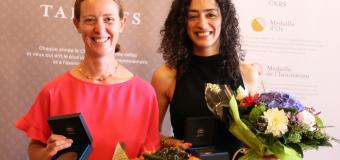
    Aude Bolopion (microrobotics) and Nadia Yousfi-Steiner (electrical engineering), two young researchers from FEMTO-ST Institute, were awarded by the CNRS bronze medal for their contribution to the advancement of French research.

    Read more
  • Secure and certify time

    Inauguration on Tuesday, July 9 of a joint laboratory between FEMTO-ST and Gorgy Timing to develop secure and certified time and frequency broadcasting systems for wireless and computer networks.

    Read more
  • Micro-soufflage de verre pour la réalisation de composants optiques miniatures

    A team of researchers from FEMTO-ST has developed miniature conical lenses by revisiting glass-blowing techniques practiced since Roman times.

    Read more
  • Detecting problems of the anti-bleeding system of patients in 60 minutes

    Researchers from FEMTO-ST institue and the Universitiy of Geneva  have developed an innovative device that investigates a patient’s platelet capacity in near real-life conditions so that bleeding can be stopped.

    Read more