
The institute
FEMTO's news

Molécules sur substrat semi-conducteur à température ambiante

La réalisation d’assemblages d’objets nanométriques sur des surfaces pour former des architectures complexes, polyfonctionnelles et stables est l’un des défis majeurs pour développer de nouveaux dispositifs possédant des propriétés nouvelles ou optimales, en particulier dans le domaine de la nano-électronique. De nombreux succès ont été obtenus, mais ils ne concernent que les surfaces métalliques et généralement à très basse température.

Molécules isolées sur Si(111)-B

Molécules isolées sur Si(111)-B

Molécules isolées sur Si(111)-B
Image 8x12nm2

Néanmoins, du point de vue applicatif, les substrats semi-conducteurs restent d’excellents candidats car ils ne nécessitent pas de rupture technologique car la micro-électronique actuelle est fondée sur leurs propriétés. De plus, les substrats semi-conducteurs sont nanostructurés et ils pourraient être utilisés en tant que moule pour étudier des molécules isolées ou de développer sur la surface des architectures moléculaires auto-assemblées. Cependant, les molécules conjuguées ne sont pas stables à température ambiante sur ces surfaces en raison de leur réactivité.

Etoile 2D sur Si(111) 7x7

Etoile 2D sur Si(111) 7x7

Etoile 2D sur Si(111) 7x7
Image 6x7nm2

Le groupe « nanosciences » vient de démontrer pour la première fois qu’il est possible d’observer des molécules organiques conjuguées qu’elles soient isolées [1] ou auto-assemblées [2] sur des substrats semi-conducteurs à température ambiante. Pour atteindre ces objectifs, les travaux mettent à profit les compétences de chacun des membres du groupe : les molécules sont conçues puis synthétisées, imagées par STM en résolution atomique et les systèmes complets (molécules substrat) sont simulés par la théorie de la fonctionnelle densité.

Les concepts originaux développés consistent à mettre à profit soit une surface de silicium dopée en atome de bore (surface SiB) pour passiver la surface [1] et donc empêcher la réaction des molécules avec les atomes de silicium, soit de protéger les électrons des molécules organiques par un groupement anionique [2].

Ces résultats sont très prometteurs car ils ouvrent une voie nouvelle pour la fabrication de dispositifs hybrides organiques/inorganiques pour la nanoélectronique en conservant les technologies.

[1] Y. Makoudi, M. Arab, F. Palmino, E. Duverger, F. Chérioux, C. Ramseyer, M. J.-L. Tschan, B. Therrien, G. Süss-Fink, Phys. Rev. Lett., sous presse, parution Février 2008.

[2] Y. Makoudi, M. Arab, F. Palmino, E. Duverger, C. Ramseyer, F. Picaud, F. Chérioux, Angew. Chem. Int. Ed., 2007, 46, 9287-9290.
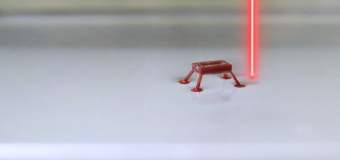
  • ThermoBot : micro robots that walk on water

    Imagine, a robot, the size of a fly, walking on the surface of the water and pursued by a laser beam. One could believe in a science fiction scenario...

    Read more
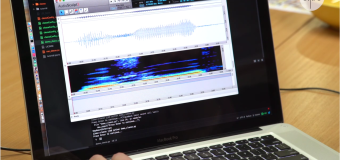
  • Recognizing liars from the sound of their voice ?

    Scientists have prouved that the intensity, speed and pitch of the speaker's voice automatically influences our perception of the reliability and honesty of his or her speech. This work is published in the prestigious journal "Nature Communications"

    Read more
  • European project for the development of sustainable and high-performance bio-based composites

    Led by FEMTO-ST and supported by the University of Franche-Comté, the « SSUCHY » R&D project which brings together 17 European partners is entering its final phase. The project is now quite advanced.

    Read more
  • Understanding the cytotoxicity of metallic nanoparticles

    A recent study published in the journal "Chemical Science" and involving FEMTO-ST gives new insights into the understanding of the mechanisms of DNA alteration in cells by metallic nanoparticles.

    Read more
  • Artificial intelligence for next-generation ultrafast photonics

    How can machine learning and associated methods improve the development of next-generation laser sources and revolutionize applications where ultrafast light plays a central role?

    Read more
  • Strong involvement of FEMTO-ST in the H2020 project "PhotonHub Europe"

    The objective of this project is to help European SMEs to increase their competitiveness through photonics with a online guidance, which will offer the support of 54 leading competence centers in Europe, including FEMTO-ST, which is also the scientific coordinator at the national level.

    Read more
  • First demonstration of self-confined nonlinear waves in plasmonic structures

    By providing the very first experimental evidence of the existence of this phenomenon, FEMTO-ST researchers and their partners hope to be able to generate this nonlinear effect using low intensity laser sources, in order to use it for nanophotonics applications.

    Read more
  • Mengjia Wang receives the « Chinese government award 2020 »

    As a PhD student of the Optics Department of FEMTO-ST , Mengjia Wang has been recognized by the Chinese Government for his outstanding work in the field of nanophotonics and plasmonics.

    Read more
  • Laurent LARGER named Fellow 2021 of OSA

    Full professor of Physics/Optics at the University of Franche-Comté and researcher at FEMTO-ST institute, Laurent Larger is rewarded for his pioneering work on nonlinear dynamics in optoelectronics and on the development of new architectures for photonic artificial intelligence.

    Read more
  • CNRS "Proof by Image" competition

     Discover the selection of the 20 images selected by the CNRS, one of which is presented by FEMTO-ST, and vote for the "audience award" photo.

    Read more