
The institute
FEMTO's news

Current Biology publie les observations par AFM des microtubules réalisées par C. Elie-Caille

Les microtubules sont des polymères protéiques appartenant au cytosquelette et peuvent être assimilés à des « rails » sur lesquels se déplacent les chromosomes avant la division cellulaire.

Les microtubules sont présents en équilibre dynamique : ils se polymérisent et se dépolymérisent en permanence. Cette dynamique repose sur l’hydrolyse du GTP garnissant les microtubules, qui fragilise la structure du microtubule en induisant une courbure de ses protofilaments constitutifs.

Comprendre le fonctionnement de ces macromolécules protéiques, dans leur ensemble (microtubules) ou au niveau de leurs entités constitutives (protofilaments) permettrait d’appréhender les phénomènes de division cellulaire dans le cas particulier des phénomènes de cancérisation.

C. Elie-Caille a ainsi montré dans Current Biology (Impact factor 11) que la microscopie à force atomique (AFM) permet d’imager des protofilaments individuels de tubuline dans leur environnement natif, à une résolution moléculaire. Ses travaux ont tout d’abord confirmé par cette approche l’effet de l’hydrolyse du GTP et d’une kinésine (MCAK) sur la conformation des protofilaments de tubuline. Elle a ensuite montré que le taxol, molécule anticancéreuse, stabilise les microtubules par « rigidification » des protofilaments, ralentissant leur transition conformationnelle « Droite à courbée ».

Ces résultats ont fait la couverture du journal.

C. Elie-Caille et al, Current Biology (2007), 17, 1765-1770, "Straight GDP-Tubulin Protofilaments Form in the Presence of Taxol".

Images AFM de protofilaments de tubuline

Images AFM de protofilaments de tubuline

Images AFM de protofilaments de tubuline

  • Tribute to Frédéric THIEBAUD

    The academic community has lost a valued colleague and friend,full professor at Marie and Louis Pasteur University and researcher at FEMTO-ST in materials science.

    Read more
  • Michel de Labachelerie receives the Legion of honor

    National recognition for this CNRS scientist, a specialist in micro and nanotechnologies, who has contributed significantly to the structuring of national and regional research as founder and first Director of the FEMTO-ST institute.

    Read more
  • Launch of the European i-Nano-T project

    The Bourgogne Franche-Comté region is banking on regional scientific and industrial synergy to drive innovation in nanomedicine.

    Read more
  • National Hydrogen Thesis Award for Clotilde ROBERT!

    This award recognizes her work on optimizing hydrogen-powered electric powertrains using a novel approach that combines technological performance, environmental sustainability, and social responsibility.

    Read more
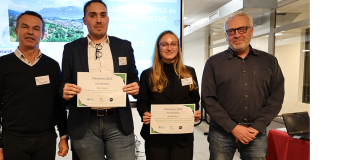
  • I-PhD Innovation competition : Two winners from FEMTO-ST in 2025

    Valentin Reynaud (microforce metrology) andGaultier Gibey (predictive maintenance of hydrogen sytems) are the winners of this sixth edition of the national innovation competition .

    Read more
  • ZETA-SE : A new start-up born out of the work of FEMTO-ST

    Founded in late July 2025, the company offers customized anti-vibration solutions for industry.

    Read more
  • RÉESPIRATION Project: When art breathes to the rhythm of science and medicine

    An interactive work of art born of an unprecedented dialogue between artists, carers and researchers to raise awareness of breathing and its calming power

    Read more
  • Fiber optic sensors: a technological leap thanks to quantum photon counting

    Researchers at FEMTO-ST have extended the range of fiber-optic temperature sensors to 150 kilometers, using photonic detection technology derived from quantum physics.

    Read more
  • Detecting hydrocarbon pollutants in groundwater

    A major environmental and health challenge taken up by FEMTO-ST researchers working with TotalEnergies

    Read more
  • Two FEMTO-ST PhD students win awards at the IFCS-EFTF 2025 international conference

    Their innovative work paves the way for new environmental monitoring devices and a new generation of atomic micro-clocks.

    Read more