

National research program on miniature robotics
FEMTO-ST is leading the MINIRO project, which brings together a national academic consortium of excellence in miniature robotics.
Miniature robotics is booming and is now establishing itself as a major strategic lever for responding to major industrial, economic, and societal challenges. By launching the PEPR Robotics program, led by the CNRS, the French government has a clear objective: to remove scientific and technological barriers in order to build robotics that is powerful, frugal, and responsible.
The MINIRO (Miniature Robotics) project, coordinated by Marie and Louis Pasteur University (UMLP), is one of the projects under this PEPR (Priority Economic Research Program) as part of France 2030.
To promote their deployment, the project focuses on three key scientific challenges:
• improving the dexterity and reliability of miniature robots,
• optimizing energy and power transmission despite severe space constraints,
• ensuring high performance despite the significant influence of their environment...
Led by the FEMTO-ST Institute in collaboration with the ICube laboratory, the MINIRO project brings together a national academic consortium of excellence comprising the UMLP, the University of Strasbourg, the CEA, Sorbonne University, the CNRS, the University of Montpellier, IMT Atlantique, the University of Technology of Compiègne, SUPMICROTECH, Inserm, ENSTA, and Grenoble INP - UGA.
By combining their complementary scientific and technological expertise, these partners aim to demonstrate the full potential of miniature robotics in order to secure France's strategic position in a field that is experiencing rapid growth worldwide.
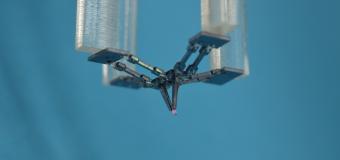
The goal is therefore to develop new technological building blocks based on innovative robotic architectures. This work will focus in particular on the design of submillimeter-sized robots with integrated actuation mechanisms, as well as the development of continuously deformable robots capable of interacting adaptively with their environment.
All of these technologies will be designed, integrated, and deployed in experimental demonstrators in order to validate their performance, robustness, and application potential.
The official launch of the project took place on February 3 and will run for 76 months, with a total budget of €8,924,156 (including €3,000,000 in funding from France 2030).
.The nine laboratories involved are: FEMTO-ST, ICube, CEA List, ISIR, Lab-STICC, LIRMM, LS2N, Laboratoire Roberval, and TIMC.
Contact : Cédric Clevy, Institut FEMTO-ST







-

INGÉNIERIE
Sciences informatiques