

Michel de Labachelerie receives the Legion of honor
National recognition for this CNRS scientist, a specialist in micro and nanotechnologies, who has contributed significantly to the structuring of national and regional research as founder and first Director of the FEMTO-ST institute.
An engineer from the École Supérieure d'Optique, he holds a doctorate from the Atomic Clock Laboratory in Orsay and joined the CNRS in 1985. He distinguished himself in the 1980s through his pioneering work in laser metrology, which was recognized with several scientific awards.
During a three-year stay in Japan, he initiated the creation in Tokyo in 1994 of a Franco-Japanese laboratory between the CNRS and the University of Tokyo on “Micro-Mechatronic Systems.”
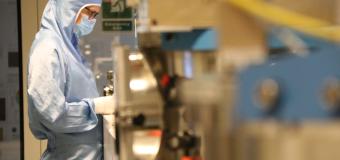
Upon his return to France—to Besançon—he played a key role in the development of regional microtechnology, with the creation of a large academic clean room for the Franche-Comté site. Founder and first director of the FEMTO-ST institute, which has become one of the CNRS's largest laboratories in engineering and computer science, he drove its scientific development by promoting interdisciplinarity and developed its international influence and innovation policy, which was recognized in particular by the award of the Carnot label in 2006 and the INPI Trophies in 2010 and 2011. He is also one of the founders of the Microtechnologies Competitiveness Cluster.
After serving two terms as director of the FEMTO-ST institute, he continues to be heavily involved at both the regional and national levels. A key player in the national and European structuring of the micro and nanotechnology field, Michel de Labachelerie coordinates an interregional Laboratory of Excellence (Labex ACTION), chairs the national “Renatech” network of large nanofabrication clean rooms at the CNRS, and is behind the creation of the EuroNanoLab network, with 15 countries and 44 European technology centers. He also coordinates the drafting of the “NanoFutur” national infrastructure of excellence project, which ranked first in the 2020 Equipex+ national call for projects.
At the same time, he contributes to the regional academic structuring of the site as Vice-President for Research at the University of Bourgogne-Franche-Comté from 2016 to 2018.
Recognized for his commitment, his sense of community, and his contribution to France's scientific influence, his work has been rewarded with the insignia of Chevalier in the National Order of the Legion of Honor.
This high distinction was presented to him by the former President of the Bourgogne-Franche-Comté Region, Marie-Guite DUFAY, on Monday, December 8, 2025, at the FEMTO-ST institute
[[{"fid":"43262","view_mode":"default","fields":{"format":"default","alignment":"","field_file_image_alt_text[und][0][value]":false,"field_file_image_title_text[und][0][value]":false,"external_url":""},"type":"media","field_deltas":{"1":{"format":"default","alignment":"","field_file_image_alt_text[und][0][value]":false,"field_file_image_title_text[und][0][value]":false,"external_url":""}},"attributes":{"class":"media-element file-default","data-delta":"1"}}]]











-

INGÉNIERIE
Sciences informatiques