

Two FEMTO-ST PhD students win awards at the IFCS-EFTF 2025 international conference
Their innovative work paves the way for new environmental monitoring devices and a new generation of atomic micro-clocks.
The 2025 International Frequency Control Symposium – European Frequency Time Forum (IFCS-EFTF) Joint Meeting, the major international conference in the field of Time-Frequency metrology, took place from May 12 to 16, 2025, in Querétaro, Mexico (https://2025.ieee-ifcs-eftf.org/).
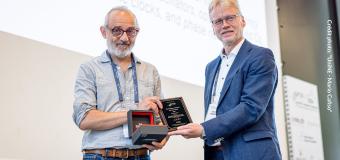
During this conference, two PhD students from Time-Frequency department of FEMTO-ST, Ghida Fawaz (COSYMA) and Carlos Rivera-Aguilar (OHMS), obtained student prizes in their respective groups.
Ghida Fawaz works on the design of an innovative surface elastic wave device for real-time monitoring of air quality, and more specifically for quantifying fine particles present in the environment. This system combines a cascade impactor with SAW sensors positioned on the impaction surface, allowing for precise separation of particles according to their size, while ensuring instantaneous measurement of their deposited mass. To ensure reliable readings, an in-depth study was conducted on the sensitivity and repeatability of the sensors to particles under various conditions. The results revealed the need to regularly clean the sensors after their exposure to polluted atmospheres. To address this challenge, a self-cleaning mechanism was integrated into the impactor, exploiting the properties of surface elastic waves to displace a water droplet and thus restore the cleanliness of the sensors. These characteristics give this device an innovative character, meeting expectations compared to the solutions currently available on the market.
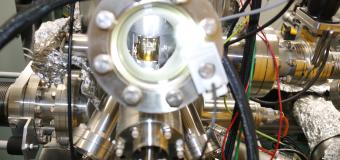
Carlos Rivera's (OHMS) studies concern the development of a microwave microcell atomic clock based on coherent population trapping. This clock, based on a Cs vapor microcell developed at FEMTO-ST (MN2S/MOSAIC, contact: N. Passilly), employs advanced pulsed interrogation techniques (Ramsey sequences) to drastically reduce the sensitivity of the clock frequency to variations in the parameters of the interrogation light field (laser power, laser frequency, etc.). The strength of C. Rivera's work was to implement this pulsed optical sequence without any external optical modulator, but by using direct modulation of the laser current. This approach maintains a compact clock architecture, compatible with real integration. The clock is controlled by an FPGA electronic board. With this method, C. Rivera-Aguilar has demonstrated a microcell atomic clock with fractional frequency stability in the low range of 10-12 at 1 day, i.e. 1 order of magnitude better than current commercial chip-scale atomic clocks (CSACs). This work could open the door to a new generation of CSACs with increased long-term stability performance, thus meeting the specifications of new applications.
Publications :
Carlos Rivera : https://doi.org/10.1063/5.0196975 , https://arxiv.org/abs/2503.01681
Contacts :
Ghida FAWAR
Carlos RIVERA




-

INGÉNIERIE
Sciences informatiques