MOCOPHYS TEAM
Modeling and Control of Multi Physics Systems (MOCOPHYS)
The MOCOPHYS team develops dynamic modeling and robust control methods for complex linear and nonlinear systems. Using energy/entropy-aware approaches, we investigate the interactions between multiphysics subsystems and their environment. Our research spans lumped and distributed parameter systems, encompassing both physics-based and data-driven physics-informed modeling, numerical tool development, and control implementation. Applications include soft robotics and micro-electromechanical systems actuated by smart materials — such as electro-active polymer actuators (IPMC, piezoelectric, HASEL, DEA) and shape memory alloys — contactless manipulation platforms based on dielectrophoresis, and systems governed by irreversible thermodynamics.
Context
Many engineering systems — soft actuators, energy harvesters, electromechanical transducers, robotic mechanisms — involve the simultaneous interplay of mechanical, electrical, thermal, and chemical phenomena. Describing these interactions within a unified and physically consistent framework remains challenging. Port-Hamiltonian systems (PHS) theory, introduced in the early 1990s, addresses this challenge by placing the stored energy (the Hamiltonian) at the core of the system description and representing interactions through power-conjugate port variables, whose product defines the exchanged power. This structure naturally captures multiphysical couplings and provides Lyapunov functions for stability analysis.
For lumped parameter systems, such as rigid-body mechanisms, the dynamics take the form :  where H(x) denotes the Hamiltonian, J(x) représents the skew-symmetric interconnection matrix, and R(x) ≥ 0 is the dissipation matrix.
The resulting passivity property plays a central role in both system analysis and control design. For spatially distributed systems, such as flexible structures, an infinite-dimensional formulation based on Stokes–Dirac structures extends these properties to distributed-parameter models, admitting similar stability results through semigroup theory.
This framework is particularly relevant for multiphysics systems actuated by smart materials, such as electro-active polymer actuators (e.g. ionic polymer metal composites (IPMC), piezoelectric, Hydraulically Amplified Soft ELectrostatic (HASEL), dielectric elastomer actuators (DEA)) and shape memory alloys, where coupling between physical domains is intrinsic. By describing energy storage and dissipation within each domain and interconnecting them through ports, PHS models provide a modular and consistent representation.
The passivity property of PHS also provides a natural framework for control design. In passivity-based control (PBC) — and more specifically control by interconnection (CbI) and interconnection and damping assignment (IDA-PBC) — the closed-loop energy is shaped so that the desired equilibrium becomes a stable minimum of a modified Hamiltonian, which then serves directly as a Lyapunov function. Extensions to distributed parameter systems, through both boundary control and in-domain actuation, are also possible, though they raise additional mathematical difficulties that remain an active area of investigation.
Current research also addresses systems governed by irreversible thermodynamics, where entropy production is strongly coupled with the other state variables, calling for an extension of the port-Hamiltonian framework beyond its classical energy-only formulation.
Objectives
The MOCOPHYS team is devoted to the development of energy/entropy-based modeling frameworks and passivity-based control strategies for nonlinear multiphysics systems, with a particular emphasis on distributed parameter systems and on experimental validation.
The MOCOPHYS team is structured in the following scientific themes :
• Port-Hamiltonian modeling of multiphysics systems develops structured mathematical models for systems in which mechanical, electrical, and thermal dynamics are strongly coupled. Within the port-Hamiltonian framework, models are constructed by characterizing energy storage and dissipation in each physical domain and assembling them through power-preserving port interconnections. Both lumped parameter systems (governed by ordinary differential equations) and distributed parameter systems (governed by partial differential equations over spatial domains) are considered. Physics-based and data-driven physics-informed modeling approaches are both employed. Particular attention is given to electroactive polymer actuators (IPMC, piezoelectric, HASEL, DEA), shape memory alloy actuators, and systems actuated by dielectrophoresis, for which the port-Hamiltonian structure provides a modular and physically consistent representation of the underlying multiphysics
• Structure-preserving discretization addresses the development of numerical schemes that preserve the underlying Dirac structure of port-Hamiltonian systems when moving from a continuous to a discrete representation. In particular, mixed finite element methods and finite-difference methods on staggered grids are developed for the discretization of distributed parameter systems in both space and time. These schemes ensure that the resulting finite-dimensional models retain the energy balance and passivity properties of the original system.
• Passivity-basedcontrol for finite-and infinite-dimensional systems addresses the design of physically interpretable control laws that exploit the passivity and energy structure of port-Hamiltonian models. Energy shaping and damping injection are the central methodologies: they modify the closed-loop Hamiltonian and damping structure so that the desired operating point becomes a stable equilibrium, with the shaped Hamiltonian serving as a Lyapunov function. For distributed parameter systems, using both early lumping and late lumping approaches, both well-posedness and stability of the resulting closed-loop system are carefully examined. Since the designed controllers are state-feedback laws, their implementation requires the joint design of observers, and observer-based control is therefore an integral part of this theme. All methodologies are validated on experimental platforms, including robotic systems and soft actuator prototypes developed within the team.
• Irreversible thermodynamics extends the port-Hamiltonian framework to systems in which entropy production is strongly coupled with the other state variables. New port-Hamiltonian structures are being developed to capture this coupling and provide an energy/entropy-consistent description of such systems, opening the way to passivity- and entropy-based control strategies with entropy assignment, in line with the team's broader control methodology.
Know-How
The MOCOPHYS team is specialized in :
• Energy-based modeling.The team works on the modeling of both lumped and distributed parameter systems using explicit and implicit port-Hamiltonian formulations, combining physics-based and data-driven physics-informed modeling approaches, with extensions to systems governed by irreversible thermodynamics.
• Structure-preserving discretization. Spatial discretization schemes — mixed finite element methods and finite-difference methods on staggered grids — that preserve the underlying Stokes-Dirac structure of distributed parameter port-Hamiltonian systems, combined with structure-preserving time-integration schemes to complete the discretization in time and in space.
• Control and observer design of nonlinear sytems. Control design is addressed for both finite-dimensional and infinite-dimensional port-Hamiltonian systems, with energy shaping, damping injection, and entropy assignment as the primary methodologies for nonlinear systems, including extensions to systems governed by irreversible thermodynamics. Observer design for nonlinear systems is also investigated, both as a standalone problem and in the context of observer-based control implementation, with well-posedness and stability analysis relying in part on semigroup theory for distributed parameter systems.
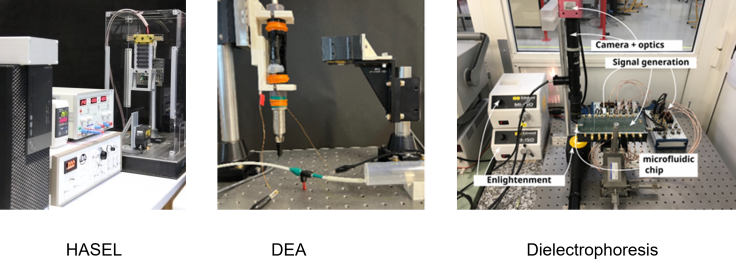
• Experimental platforms and implementation. The team fabricates and characterizes electroactive polymer actuators and micro-fluidic chips, providing the physical benchmarks on which modeling and control methods are validated. This experimental activity encompasses system identification, parameter estimation, and the real-time control implementation using dSPACE platforms.
Implementation