
The institute
FEMTO's news

Micro-soufflage de verre pour la réalisation de composants optiques miniatures

A team of researchers from FEMTO-ST has developed miniature conical lenses by revisiting glass-blowing techniques practiced since Roman times.

For centuries, glass blowing is, indeed, a technique for making  glass parts in volume. A FEMTO-ST research team recently applied it on a microscopic scale to collectively produce a particular optical component, a miniature axicon, on the same substrate.

This component is in fact a conical microlens whose profile allows to generate quasi-Bessel beams, that is to say non-diffracting beams. This allows to create a miniature light saber or a light needle.

In an article published on June 25, 2019 in Optics Letters (and selected by the Optical Society of America in its News Releases), researchers presented a technique for manufacuring miniature axicons based on glass blowing. from structured micro-cavities in a silicon substrate and sealed with a glass substrate. When the stack is highly heated, the expansion of the trapped gas, combined with the drop in  glass viscosity, forms bubbles used as pistons to generate and control a profile on the opposite side of the glass substrate. Once the pistons removed by polishing, hundreds of axicons can be obtained on the same substrate. Robust, they are destined to be integrated in more complex microsystems for medical imaging or in the extension of machining performance.

“Microscopic Glass Blowing Used to Make Tiny Optical Lenses”, Optics Letters News, June 2019. https://www.osa.org/en-us/about_osa/newsroom/news_releases/2019/microscopic_glass_blowing_used_to_make_tiny_optica/

Article: J. V. Carrión, J. Albero, M. Baranski, C. Gorecki, N. Passilly, “Microfabrication of axicons by glass blowing at a wafer-level,” Opt. Lett., 44, 13, 3282-3285 (2019).         
DOI: https://10.1364/OL.44.003282.

More informations : Nicolas Passily
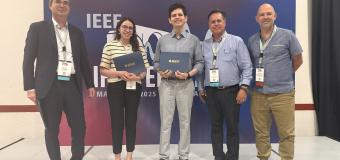
  • Elsevier article award at BFAS 2024

    Artificial intelligence applied to the electroerosion machining process : Loïc Guiziou1, Emmanuel Ramasso1, Sébastien Thibaud1 et Sébastien Denneulin2 won second prize for best paper at the 8th International Conference on Belief Functions.

    Read more
  • Tribute to our colleague Sarah Benchabane

    The CNRS and the university community of Bourgogne Franche-Comté are in mourning following the death of Sarah Benchabane, Director of Research at the CNRS and internationally renowned researcher in phononics, affiliated to the FEMTO-ST laboratory.

    Read more
  • Does the i-motif structure of DNA exist in the cell?

    As part of an interdisciplinary project involving FEMTO-ST, a new scientific study is reopening the debate on the very existence of these structures in DNA and their potential therapeutic interest in cell biology for the treatment of certain cancers.

    Read more
  • Lancement du projet européen FEDER régionalisé BioIMP

    Une alliance des experts de la santé et des microtechniques pour optimiser la fabrication des biomédicaments.

    Read more
  • Pink October: A smart bra project

    Zeina Al Masry talks to France 3 TV about her innovative connected bra project for the early detection of breast cancer.

    Read more
  • Vincent Giordano,winner of the EFTF Award 2024

    This award recognises a career spanning more than 35 years of research into frequency metrology, including the development of sapphire oscillators.

    Read more
  • Electronique moléculaire : un nouveau regard sur l’organisation des molécules ioniques

    Des scientifiques de l’Institut de chimie de Strasbourg et de FEMTO-ST ont développé une méthode innovante permettant d’améliorer la caractérisation des interfaces ioniques à l’échelle nanométrique, et ainsi d’analyser de nouveaux matériaux pressentis pour s’insérer dans la prochaine génération d

    Read more
  • Ondes de spin optiques, un nouvel état de la lumière

    Les états magnétiques présents dans la matière sont une source d’inspiration pour imaginer de nouveaux états de la lumière. Une équipe de l’institut FEMTO-ST a conçu puis créé un équivalent optique des ondes dites « de spin » se propageant dans les aimants.

    Read more
  • FEMTO-ST celebrates its 20th anniversary

    Surrounded by its co-supervisors and partners, the FEMTO-ST institute celebrated its 20th anniversary on Wednesday 26 June in Besançon.

    Read more
  • Eric MAZUR (Harvard Université) en conférence à FEMTO-ST

    Professeur à l'Université de Harvard, ce scientifique de renommée internationale dans le domaine des  interactions ultrarapides entre la lumière et la matière et la science des matériaux  est intervenu dans nos locaux ce vendredi 21 Juin.

    Read more