
UPWEARS Project: From Plant Fibers to Textiles
Through the European UPWEARS project, researchers at FEMTO-ST are exploring the potential of bio-based materials—from their mechanical behavior to the integration of electronic functions capable, in particular, of detecting environmental pollutants.
For plant-based fibers for the textiles of tomorrow:
How can we design high-performance, smart, and more environmentally friendly textiles? That is the goal of the European UPWEARS project, funded by the Horizon Europe program, which brings together 14 academic and industrial partners from 7 countries (including New Zealand) to develop a new generation of technical textiles using bio-based resources such as flax, hemp, and cork.
The project, which will run for four years, from September 2024 to August 2028, has a total budget of 7.8 million euros, of which 7 million are funded by Horizon Europe. INRAE is coordinating the project.
Beyond replacing synthetic fibers, the project aims to develop a complete value chain, from the processing of plant-based fibers to their incorporation into functional, connected, and recyclable textiles.
Within the consortium, Marie and Louis Pasteur University, through FEMTO-ST, is contributing to our understanding of the behavior of plant fibers and to the development of microelectronic functions integrated into textiles.
Understanding how plant fibers respond to their hygrothermal environment
The MAT’ECO and MICRO teams in FEMTO-ST’s Department of Applied Mechanics are studying the structure and mechanical behavior of plant fibers and the yarns made from them.
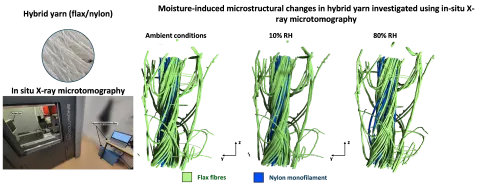
Their properties vary, in particular, depending on their internal structure and environmental conditions. Moisture, for example, can cause the fibers to swell and alter their mechanical properties.
Using X-ray microtomography, conducted under various humidity conditions at the MIFHySTO platform, researchers can observe in 3D how the structure of the yarns changes and the associated deformations.
This research helps establish a better link between fiber structure and the behavior of yarns and textiles, and enables the development of predictive models tailored to the variability of plant-based materials.
Plant fibers that are sensitive to their environment
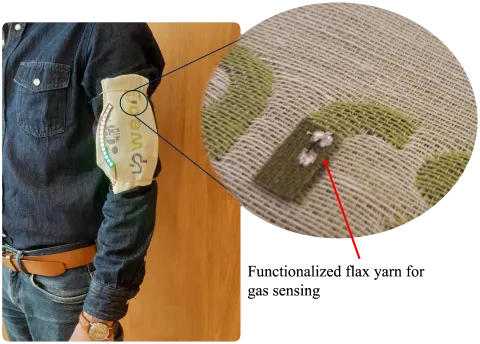
FEMTO-ST’s second contribution to UPWEARS aims to integrate gas microsensors directly into textiles to monitor the wearer’s exposure to certain pollutants.
Led by Jean-Baptiste Sanchez in the Micro Nano Sciences & Systems department, this research explores, in particular, the use of bio-based materials derived from lignin—a byproduct of flax and hemp—to develop compact, energy-efficient sensors suitable for connected textiles.
Sensors embedded in fabric
Jean-Baptiste Sanchez's research focuses on developing resistive gas microsensors made from bio-based materials that can operate at room temperature to minimize their energy consumption.
Embedded in a flexible fabric and combined with artificial intelligence, these sensors will be able to detect various chemical signatures and pave the way for clothing capable of monitoring its environment in real time.
A convergence of bio-based materials, mechanics, and electronics
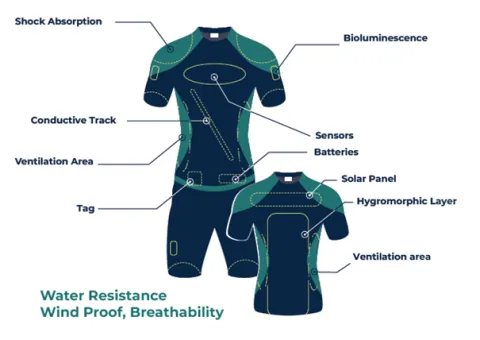
What sets UPWEARS apart is its ability to combine plant-based fibers, materials, microelectronics, and artificial intelligence to design smart, bio-based textiles.
FEMTO-ST's research contributes to this approach, ranging from an understanding of fibers to the development of sensors capable of analyzing the environment, with the goal of creating multifunctional, sustainable, and circular textiles.
Toward Textiles That Sense Their Environment
The research aims to improve sensor performance and their integration into flexible textiles. Ultimately, the combination of plant-based materials, microsensors, and artificial intelligence could lead to the development of clothing capable of detecting and analyzing its environment in real time, with applications in technical textiles, air quality monitoring, and wearable environmental monitoring systems.
Contact : Vincent Placet




-

INGÉNIERIE
Sciences informatiques