
The institute
FEMTO's news

UPWEARS Project: From Plant Fibers to Textiles

Through the European UPWEARS project, researchers at FEMTO-ST are exploring the potential of bio-based materials—from their mechanical behavior to the integration of electronic functions capable, in particular, of detecting environmental pollutants.

For plant-based fibers for the textiles of tomorrow:

How can we design high-performance, smart, and more environmentally friendly textiles? That is the goal of the European UPWEARS project, funded by the Horizon Europe program, which brings together 14 academic and industrial partners from 7 countries (including New Zealand) to develop a new generation of technical textiles using bio-based resources such as flax, hemp, and cork.

The project, which will run for four years, from September 2024 to August 2028, has a total budget of 7.8 million euros, of which 7 million are funded by Horizon Europe. INRAE is coordinating the project.

Beyond replacing synthetic fibers, the project aims to develop a complete value chain, from the processing of plant-based fibers to their incorporation into functional, connected, and recyclable textiles.

Within the consortium, Marie and Louis Pasteur University, through FEMTO-ST, is contributing to our understanding of the behavior of plant fibers and to the development of microelectronic functions integrated into textiles.

Understanding how plant fibers respond to their hygrothermal environment

The MAT’ECO and MICRO teams in FEMTO-ST’s Department of Applied Mechanics are studying the structure and mechanical behavior of plant fibers and the yarns made from them.

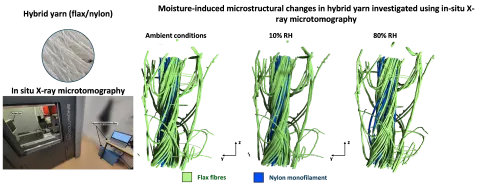
Their properties vary, in particular, depending on their internal structure and environmental conditions. Moisture, for example, can cause the fibers to swell and alter their mechanical properties.

Using X-ray microtomography, conducted under various humidity conditions at the MIFHySTO platform, researchers can observe in 3D how the structure of the yarns changes and the associated deformations.

This research helps establish a better link between fiber structure and the behavior of yarns and textiles, and enables the development of predictive models tailored to the variability of plant-based materials.
 

Image
upwears 1


Plant fibers that are sensitive to their environment

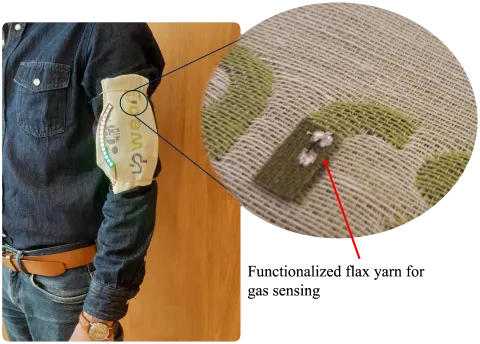
FEMTO-ST’s second contribution to UPWEARS aims to integrate gas microsensors directly into textiles to monitor the wearer’s exposure to certain pollutants.

Led by Jean-Baptiste Sanchez in the Micro Nano Sciences & Systems department, this research explores, in particular, the use of bio-based materials derived from lignin—a byproduct of flax and hemp—to develop compact, energy-efficient sensors suitable for connected textiles.

Sensors embedded in fabric

Jean-Baptiste Sanchez's research focuses on developing resistive gas microsensors made from bio-based materials that can operate at room temperature to minimize their energy consumption.

Embedded in a flexible fabric and combined with artificial intelligence, these sensors will be able to detect various chemical signatures and pave the way for clothing capable of monitoring its environment in real time.
 

Image
Upwears 2


A convergence of bio-based materials, mechanics, and electronics

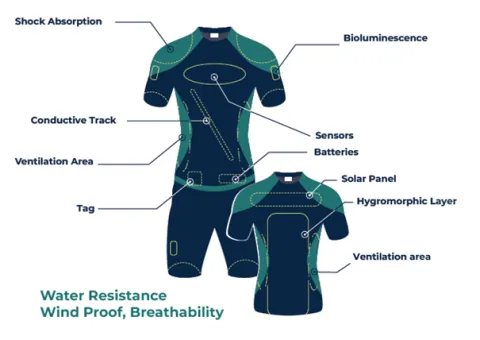
What sets UPWEARS apart is its ability to combine plant-based fibers, materials, microelectronics, and artificial intelligence to design smart, bio-based textiles.

FEMTO-ST's research contributes to this approach, ranging from an understanding of fibers to the development of sensors capable of analyzing the environment, with the goal of creating multifunctional, sustainable, and circular textiles.

Toward Textiles That Sense Their Environment

The research aims to improve sensor performance and their integration into flexible textiles. Ultimately, the combination of plant-based materials, microsensors, and artificial intelligence could lead to the development of clothing capable of detecting and analyzing its environment in real time, with applications in technical textiles, air quality monitoring, and wearable environmental monitoring systems.
 

Image
Upwears 3


Contact : Vincent Placet

  • Création de la Start-up AFULub

    La start-up AFULub fait son entrée dans l'incubateur.

    Read more
  • Publication dans Nature Communications

    Novembre 2014 :

    parution de l'article

    « Protrusion force microscopy reveals oscillatory force generation and mechanosensing activity of human macrophage podosomes »

    Read more
  • On a marché sur les braises !

    Un dimanche presque comme les autres à la Fabrikà sciences. Dimanche 14 décembre 2014, John Dudley (chercheur à l'Institut FEMTO-ST) proposait au public de marcher sur les braises.

    Read more
  • Paper prize at the international conference VPPC 2014

    At the International IEEE "Vehicle Power and Propulsion Conference" conference held in Coimbra, Portugal from 27 to 30 October 2014, “Hybrid & Fuel Cell Systems” Research Team of Femto-ST Institute won the Paper Prize for the paper titled “Energy management of an hybrid electrical vehicule in degraded operation”

    Read more
  • Paper prize lors de la conférence internationale VPPC 2014

    Lors de la conférence internationale IEEE « Vehicule Power and Propulsion Conference » qui s’est déroulée à Coimbra au Portugal du 27 au 30 octobre 2014, l’équipe Systèmes Hybride et Systèmes Pile à Combustible »du département Energie de FEMTO-ST a remporté le « Paper Prize » pour son article intitulé « Gestion d'énergie d'un véhicule électrique hybride en fonctionnement dégradé »

    Read more
  • Best Paper Award pour proposer l’interopérabilité des systèmes de communication des armées

    L’article présenté fin octobre à Rome par une équipe de FEMTO-ST/ Département Informatique des Systèmes Complexes, a reçu le prix du meilleur article scientifique lors de la conférence européenne du Wireless Innovation Forum. Les résultats présentés portaient sur l’application des méthodes de génération de tests à partir de modèles formels pour vérifier la conformité au standard du logiciel embarqué dans ces équipements, permettant d’assurer ainsi leur interopérabilité.

    Read more
  • Yannick Lefier, vainqueur de la Grande Battle de FEMTO-ST !

    Vulgariser ses travaux de recherche avec humour et en moins de 3 minutes. C’est le défi dans lequel se sont lancés huit doctorants de FEMTO-ST qui se sont affrontés à coups de « supers pouvoirs » au cours de cette édition 2014 de la fête de la science. Après une première épreuve qui s’est déroulée à l’UFR-STGI de Belfort, le 9 octobre dernier devant 130 lycéens, Yannick Lefier s’est imposé lors de la finale qui a eu lieu le 12 octobre à Besançon avec 30 % des votes du public pour la présentation de ses travaux en optique… déguisé en grand maître de la lumière karatéka !

    Read more
  • Un nouveau mode de diffusion de la lumière dans de minuscules fibres optiques

    Des chercheurs de l'institut Femto-ST en collaboration avec des collègues du Laboratoire Charles Fabry viennent de découvrir un nouveau mode de diffusion de la lumière dans de minuscules fibres optiques 50 fois plus fines qu'un cheveu ! Ce phénomène, qui varie selon l'environnement de la fibre, pourrait être exploité pour concevoir des capteurs innovants et ultra-sensibles. Ces travaux sont publiés le 24 octobre 2014 dans la revue Nature Communications.

    Read more
  • Congrès CETSIS - 27-29 octobre 2014

    Besançon accueille le congrès CETSIS 2014 du 27 au 29 octobre 2014. Il se déroule essentiellement autour de démonstrations réelles de travaux pratiques et de projets et de tables rondes et accueillera des enseignants, enseignants-chercheurs, doctorants, industriels de toute la France et de pays francophones.

    Read more
  • Visite du Premier ministre, Manuel Valls, à FEMTO-ST

    Accompagné de Mme Najat Vallaud-Belkacem, Ministre de l'Éducation nationale, de l'Enseignement supérieur et de la Recherche, et Mme Geneviève Fioraso, Secrétaire d’Etat à l’Enseignement supérieur et à la Recherche, le Premier Ministre Manuel Valls est venu découvrir, lundi 29 septembre à Besançon, les recherches menées au sein de l’institut et apprécier les développements technologiques réalisés au sein de notre salle blanche.

    Read more