
The institute
FEMTO's news

The W. G. Cady Prize awarded to Serge GALLIOU at the IEEE IFCS 2019

This award recognizes Serge Galliou's exceptional and pioneering contributions in the development of cryogenic acoustic resonators with extremely high quality factors (very low mechanical losses) for sensor, oscillator or fundamental physics applications.

Awarded annually since 1983, the Cady Prize is an international scientific recognition of the  "IEEE Ultrasonics, Ferroelectrics & Frequency Control Society" which, this year, honours Professor Galliou's innovative research on the behaviour of quartz resonators at very low temperatures. His work has made it possible to experimentally determine the ultimate limits of oscillators based on volume acoustic wave resonators. They have improved knowledge of limitations due to mechanical losses and thermal noise thanks to an original tool (cryogener) and more fundamental means of investigation (analysis of acoustic wave/thermal photon interactions, measurement of elastic coefficients).

This work is of great interest to many researchers involved in astronomy programs on gravitational waves, whose detection uses materials with very low losses, and quantum measurements.

[[{"fid":"4025","view_mode":"default","fields":{"format":"default","alignment":"","field_file_image_alt_text[und][0][value]":false,"field_file_image_title_text[und][0][value]":false,"external_url":""},"type":"media","field_deltas":{"1":{"format":"default","alignment":"","field_file_image_alt_text[und][0][value]":false,"field_file_image_title_text[und][0][value]":false,"external_url":""}},"attributes":{"class":"media-element file-default","data-delta":"1"}}]]
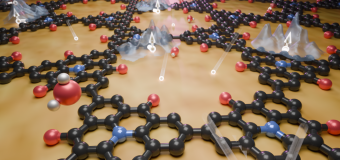
  • Kagomé structures for quantum technologies

    Quantum technologies open up promising prospects, but require the development of new materials with remarkable properties.

    Read more
  • Launch of the European SAMI project for energy-free intelligent sensors

    A major scientific and technological collaboration between Silmach and FEMTO-ST in the field of intelligent, autonomous sensors kicks off on January 30.

    Read more
  • RENATECH 2024 PhD AWARD

    Adria Grabulosa is rewarded for his work on 3D printed circuits using an original two-photon optical additive manufacturing technique.

    Read more
  • Elsevier article award at BFAS 2024

    Artificial intelligence applied to the electroerosion machining process : Loïc Guiziou1, Emmanuel Ramasso1, Sébastien Thibaud1 et Sébastien Denneulin2 won second prize for best paper at the 8th International Conference on Belief Functions.

    Read more
  • Tribute to our colleague Sarah Benchabane

    The CNRS and the university community of Bourgogne Franche-Comté are in mourning following the death of Sarah Benchabane, Director of Research at the CNRS and internationally renowned researcher in phononics, affiliated to the FEMTO-ST laboratory.

    Read more
  • Does the i-motif structure of DNA exist in the cell?

    As part of an interdisciplinary project involving FEMTO-ST, a new scientific study is reopening the debate on the very existence of these structures in DNA and their potential therapeutic interest in cell biology for the treatment of certain cancers.

    Read more
  • Lancement du projet européen FEDER régionalisé BioIMP

    Une alliance des experts de la santé et des microtechniques pour optimiser la fabrication des biomédicaments.

    Read more
  • Pink October: A smart bra project

    Zeina Al Masry talks to France 3 TV about her innovative connected bra project for the early detection of breast cancer.

    Read more
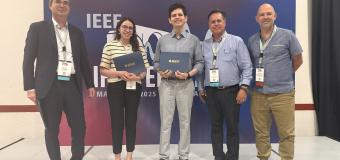
  • Vincent Giordano,winner of the EFTF Award 2024

    This award recognises a career spanning more than 35 years of research into frequency metrology, including the development of sapphire oscillators.

    Read more
  • Electronique moléculaire : un nouveau regard sur l’organisation des molécules ioniques

    Des scientifiques de l’Institut de chimie de Strasbourg et de FEMTO-ST ont développé une méthode innovante permettant d’améliorer la caractérisation des interfaces ioniques à l’échelle nanométrique, et ainsi d’analyser de nouveaux matériaux pressentis pour s’insérer dans la prochaine génération d

    Read more