

The institute
FEMTO's news

Focus on the european MiMédi project

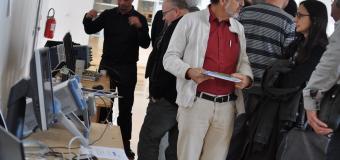
On Tuesday 11 June 2019, the teams of the FEMTO-ST Institute and the EFS Bourgogne-Franche-Comté will present, in the presence of representatives of the regional district, an important European research project on regional smart specialisation.  Bringing together 10 industrial and academic partners, it aims to optimize the manufacture of "drug cells" through new technological solutions.

Innovative medicines (Medi) have recently emerged to offer new treatment solutions for patients in therapeutic impasse. These "Medi" are based on the use of "drug cells" with new physiological functions, biological characteristics or reconstitutional properties inspired by the body's natural processes, but the manufacture of these drugs requires the use of complex technologies for cell sorting, amplification, genetic transduction, amplification-division, activation, at several stages of production and all this in a controlled clean room environment. Given these different manufacturing constraints, their production is therefore expensive. This is why a new conception of the current mode of production and qualification of the Medias is necessary.

This is the subject of the FEDER MiMédi project - Microtechniques pour les Médicaments Innovants - of smart specialisation (RIS3) which will make it possible to combine microtechnical skills with those of the production of tomorrow's medicines, paving the way for a promising future sector in the Region. These developments should ultimately facilitate the marketing of innovative medicines to combat public health problems such as cancer, inflammation and tissue repair.

This 4-year project, with a total budget of €13.6 million, is financed to the tune of €10.2 million by ERDF funds, €584,000 by the Regional Innovation Fund (RIF) and €2.8 million in self-financing. It is supported by ILSA and involves 5 other industrial partners, a transfer centre and 3 academic partners, including the University of Franche-Comté via FEMTO-ST.
See the website dedicated


  • La Nuit européenne des chercheurs

    Avez-vous déjà participé à une expérience en tant que cobaye ? Avez-vous déjà visité le parc de l’Observatoire la nuit ? Avez-vous déjà discuté avec des inconnus dans le noir ? Venez faire de nouvelles expériences pendant la Nuit des chercheurs !

    Read more
  • Vers une généralisation de l’utilisation des horloges atomiques miniatures

    Rendre moins chères et plus compactes, les micro horloges atomiques afin d’envisager leur intégration dans de nombreux systèmes nécessitant une meilleure stabilité de temps, tels sont les travaux menés par les chercheurs de FEMTO-ST qui leur valent aujourd’hui un article dans la prestigieuse revue scientifique « Scientific reports »

    Read more
  • L'Expérience holographique

    Une exposition exceptionnelle d'hologrammes dans le cadre de LUX!

    Read more
  • Frontiers in photonics

    Venez assister aux conférences d'Alexander Gaeta, de Michal Lipson et de Jean-Pierre Wolf le 1er octobre...

    Read more
  • Venez découvrir le dispositif CIFRE

    FEMTO-ST organise le mercredi 30 septembre, une demi-journée d’information sur le dispositif "Conventions Industrielles de Formation par la Recherche".

    Read more
  • A vos objectifs...

    LUX ! vous propose jusqu'au 10 septembre de participer à un concours photo à contre-jour...

    Read more
  • LUX ! À L’HEURE D’ÉTÉ

    LUX ! C’est tout l’été en Franche-Comté avec :
    Des ateliers, des rencontres, des expositions et des animations grand public, mais aussi des intervenants spécialisés chercheurs, artistes, médiateurs...

    Read more
  • AFULUB lauréat i-LAB 2015

    AFULub est lauréat régional de la catégorie "en émergence" de la 17ème édition du Concours national d’aide à la création d’entreprises de technologies innovantes

    Read more
  • EFTS - Séminaire européen temps-fréquence

    Du 29 juin au 3 juillet se déroule l'école thématique EFTS organisée par le département Temps-Fréquence...

    Read more
  • Mieux connaître l’impact des particules de suie sur le climat

    En appliquant un modèle basé sur une nouvelle approche théorique dite PDI (Point Dipole Interaction) à des particules de suie simulées sur ordinateur, une équipe de chercheurs bisontins vient de montrer que les caractéristiques atomiques de ces particules, émises par les processus de combustion, peuvent avoir une grande influence sur leurs propriétés d’absorption du rayonnement solaire.

    Read more


