
The institute
FEMTO's news

Michaël Gauthier reçoit une médaille de Bronze du CNRS 2011

Michaël Gauthier est lauréat 2011 de l’Institut des sciences de l'ingénierie et des systèmes (INSIS) du CNRS. Suivant la formule officielle, "La médaille de bronze récompense le premier travail d'un chercheur, qui fait de lui un spécialiste de talent dans son domaine. Cette récompense représente un encouragement du CNRS à poursuivre des recherches bien engagées et déjà fécondes."

Michaël Gauthier a été recruté au CNRS en 2003 comme chargé de recherche 2nd classe et a été affecté au Laboratoire d’Automatique de Besançon, devenu le département AS2M de l’institut FEMTO-ST. Son activité scientifique porte sur le domaine de la micromanipulation robotique : manipulation d’objets de taille micrométrique par un robot. Ses travaux portent sur une approche originale qui consiste à réaliser les opérations de manipulation et d’assemblage dans un milieu liquide.

michael gauthier médaille

michael gauthier médaille

michael gauthier médaille

Les études menées vont de la modélisation des phénomènes comme la manière dont se comporte des micro-objets en fonction du pH du milieu ; à des activités de transfert via la participation à la start-up Percipio Robotics (www.percipio-robotics.com); en passant par l’étude de méthodes robotiques de micromanipulation comme par exemple la commande haute vitesse de micromanipulation sans contact à l’aide de champs électriques.

Voir les lauréats sur le site du CNRS

  • Two CNRS bronze medals for FEMTO-ST

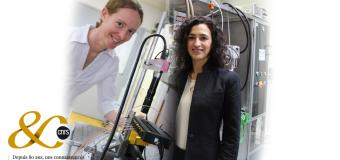
    Aude Bolopion (biomedical micro-nano robotics) and Nadia Steiner (fuel cell diagnostics) are awarded with the CNRS 2019 bronze medal for their promising research.

    Each year, the CNRS bronze medals welcome some 40 young scientists whose career start is extremely promising

    Read more
  • Best student paper award for Rémi Meyer

    Remi Meyer got the best student presentation award at SPIE-Photonics West conference for his work on ultra-high aspect ratio Bessel beams. Shaping the beam of ultrafast lasers has become now an essential tool for ultra-high intensity laser-matter interaction.

    Read more
  • Visit of the CNRS President to FEMTO-ST

    Antoine Petit, CEO of the CNRS, was welcomed on February 11th at FEMTO-ST.


    Read more
  • Visite du Préfet du Doubs à FEMTO-ST

    Joël MATHURIN, nouveau Préfet du Doubs, est venu découvrir les activités de recherche de FEMTO-ST vendredi 25 janvier dernier.

    Read more
  • John Dudley awarded by the international Society of Optics and Photonics (SPIE)

    He obtains  the "SPIE Harold E. Edgerton" Award 2019 for pioneering applications based on ultra-short light pulses in optical fibers.

    Read more
  • Award "innovation in optomechatronic research"

    Several members of different scientific departments of FEMTO-ST were rewarded for their joint paper "Photonic microsystem made by dynamic microassembly" at the ISOT conference "19th International Symposium on Optomechatronic Technology" which took place from November 5 to 8 in Cancun

    Read more
  • Entrepreneurs-PhD Award : Second place for Vladimir Gauthier at the national level

    Awarded for his « CellSelect project » he proposes a robot capable of improving the precision and speed of cell sorting in the field of innovative therapies.

    His work is the result of research carried out of Biomedical Microrobotics Team of FEMTO-ST Institute.

    Read more
  • Jean-Antoine Seon : awarded with the 2nd national PHD prize in robotics

    Jean Antoine was distinguished on November 22th at the CNRS headquarters for his pioneer international work on a micro robotic dextral hand.

    Read more
  • Elodie Pahon is the award winner of "Hydrogen Europe Research young Scientist" in the transport field

    This award recognizes her high-level works that aim developping prognosis and smart control approaches dedicated to fuel cell systems. 
    Read more
  • Emmanuel RAMASSO, recipient of a « Group Achievement Award » by NASA

    For outstanding contributions to the open data initiative by conducting and posting experimental system fault and run-to-failure data sets with exceptional scientific value.

    Read more