
The institute
FEMTO's news

Toward a new generation of recyclable composites

The PEPR RECYCOMP project, in collaboration with the FEMTO-ST Institute, is developing recyclable high-performance composites for a circular economy.

Composites, which combine a fibrous reinforcement (carbon, glass, flax, etc.) with a polymer matrix, offer both lightness and mechanical performance.  These materials are thus increasingly used in many industrial sectors such as aerospace, automotive, energy, and sports. However, recycling them by separating the fiber and matrix components—remains a complex challenge today, exacerbated by the ever-increasing volume of end-of-life materials.

As part of the PEPR (Priority Research Programs and Equipment) “Recycling, Recyclability, and Reuse of Materials,” the RECYCOMP project (ANR-22-PERE-0005) aims to address this major industrial and environmental challenge by developing a new generation of recyclable organic matrix composite materials without compromising mechanical performance.Bringing together nine research laboratories from across the country, this four-year project—which began in February 2023—explores two innovative approaches: supercritical solvolysis and twin-screw extrusion, using end-of-life components from wind turbine blades, ships, and automotive sandwich structures.  In addition, the project also proposes incorporating the recycling process into the material’s design from the outset. For example, flax fibers are first surface-treated with iron oxides to impart magnetic properties to them, enabling the selective recycling of their components.

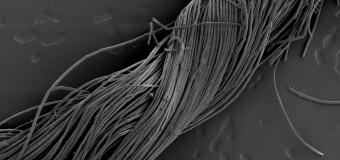
The contribution of the FEMTO-ST Institute, through Adam LEVEZIEL’s thesis, is to characterize the interfacial properties of the materials developed in the RECYCOMP project at the micro-scale. Indeed, the fiber-matrix interface plays a crucial role in the mechanical performance of composites. To this end, a comprehensive study was conducted on the detachment of microdroplets from individual fibers. This test involves measuring, on a single fiber approximately 10 to 20 µm in diameter (thinner than a human hair), the force required to detach a microdroplet of polymer resin in order to evaluate the fiber-matrix bond in a composite.

In particular, an in situ device was developed with support from the MIMENTO, MIFHySTO, and AMETISTE platforms to enable this test to be conducted in an X-ray microtomograph and thus observe, for the first time in real time, the interfacial damage mechanisms responsible for the composite’s failure. The results obtained therefore provide a better understanding of the behavior of the fiber/matrix interface in the materials developed in the RECYCOMP project.

Ultimately, this research paves the way for the development of materials that are more durable, high-performance, and easier to recycle, addressing the environmental and industrial challenges of the future.



Read n° 168 of JEC COMPOSITES Magazine : https://digital-magazine.jeccomposites.com/
 
  • Understanding energy transfers during photosynthesis

    Using three pigments manipulated by scanning tunneling microscopy, researchers from IPCMS and FEMTO-ST are studying energy transfers between molecules to gain a finer understanding of the photosynthesis mechanism in plants. This work is published in Nature Chemistry.

    Read more
  • International Day of Light on May 16th

    This year, the Student Chapter of FEMTO-ST organizes on this occasion a photo contest on the theme ′′ Light phenomena in everyday life ".

    Read more
  • AMAROB labelled Deep Tech company

    Spin off of FEMTO-ST, Amarob technologie has received the Deep Tech company label awarded by Bpifrance.

    Read more
  • New platform to support the design and optimization of fuel cell hybride system and battery

    Virtual FCS" is the first freely accessible online simulation platform to support fuel cell manufacturers and users.

     Supported by a European funding, "Virtual FCS" has for French partner the University of Bourgogne-Franche-Comté through the FEMTO-ST institute and the FC-LAB

    Read more
  • ThermoBot : micro robots that walk on water

    Imagine, a robot, the size of a fly, walking on the surface of the water and pursued by a laser beam. One could believe in a science fiction scenario...

    Read more
  • Recognizing liars from the sound of their voice ?

    Scientists have prouved that the intensity, speed and pitch of the speaker's voice automatically influences our perception of the reliability and honesty of his or her speech. This work is published in the prestigious journal "Nature Communications"

    Read more
  • European project for the development of sustainable and high-performance bio-based composites

    Led by FEMTO-ST and supported by the University of Franche-Comté, the « SSUCHY » R&D project which brings together 17 European partners is entering its final phase. The project is now quite advanced.

    Read more
  • Understanding the cytotoxicity of metallic nanoparticles

    A recent study published in the journal "Chemical Science" and involving FEMTO-ST gives new insights into the understanding of the mechanisms of DNA alteration in cells by metallic nanoparticles.

    Read more
  • Artificial intelligence for next-generation ultrafast photonics

    How can machine learning and associated methods improve the development of next-generation laser sources and revolutionize applications where ultrafast light plays a central role?

    Read more
  • Strong involvement of FEMTO-ST in the H2020 project "PhotonHub Europe"

    The objective of this project is to help European SMEs to increase their competitiveness through photonics with a online guidance, which will offer the support of 54 leading competence centers in Europe, including FEMTO-ST, which is also the scientific coordinator at the national level.

    Read more