
The institute
FEMTO's news

Toward a new generation of recyclable composites

The PEPR RECYCOMP project, in collaboration with the FEMTO-ST Institute, is developing recyclable high-performance composites for a circular economy.

Composites, which combine a fibrous reinforcement (carbon, glass, flax, etc.) with a polymer matrix, offer both lightness and mechanical performance.  These materials are thus increasingly used in many industrial sectors such as aerospace, automotive, energy, and sports. However, recycling them by separating the fiber and matrix components—remains a complex challenge today, exacerbated by the ever-increasing volume of end-of-life materials.

As part of the PEPR (Priority Research Programs and Equipment) “Recycling, Recyclability, and Reuse of Materials,” the RECYCOMP project (ANR-22-PERE-0005) aims to address this major industrial and environmental challenge by developing a new generation of recyclable organic matrix composite materials without compromising mechanical performance.Bringing together nine research laboratories from across the country, this four-year project—which began in February 2023—explores two innovative approaches: supercritical solvolysis and twin-screw extrusion, using end-of-life components from wind turbine blades, ships, and automotive sandwich structures.  In addition, the project also proposes incorporating the recycling process into the material’s design from the outset. For example, flax fibers are first surface-treated with iron oxides to impart magnetic properties to them, enabling the selective recycling of their components.

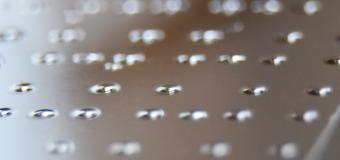
The contribution of the FEMTO-ST Institute, through Adam LEVEZIEL’s thesis, is to characterize the interfacial properties of the materials developed in the RECYCOMP project at the micro-scale. Indeed, the fiber-matrix interface plays a crucial role in the mechanical performance of composites. To this end, a comprehensive study was conducted on the detachment of microdroplets from individual fibers. This test involves measuring, on a single fiber approximately 10 to 20 µm in diameter (thinner than a human hair), the force required to detach a microdroplet of polymer resin in order to evaluate the fiber-matrix bond in a composite.

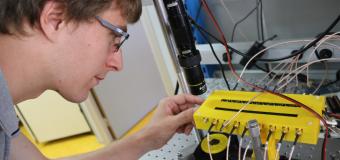
In particular, an in situ device was developed with support from the MIMENTO, MIFHySTO, and AMETISTE platforms to enable this test to be conducted in an X-ray microtomograph and thus observe, for the first time in real time, the interfacial damage mechanisms responsible for the composite’s failure. The results obtained therefore provide a better understanding of the behavior of the fiber/matrix interface in the materials developed in the RECYCOMP project.

Ultimately, this research paves the way for the development of materials that are more durable, high-performance, and easier to recycle, addressing the environmental and industrial challenges of the future.


Read n° 168 of JEC COMPOSITES Magazine : https://digital-magazine.jeccomposites.com/
 
  • Two young regional researchers awarded by the CNRS bronze medal

    Aude Bolopion (microrobotics) and Nadia Yousfi-Steiner (electrical engineering), two young researchers from FEMTO-ST Institute, were awarded by the CNRS bronze medal for their contribution to the advancement of French research.

    Read more
  • Secure and certify time

    Inauguration on Tuesday, July 9 of a joint laboratory between FEMTO-ST and Gorgy Timing to develop secure and certified time and frequency broadcasting systems for wireless and computer networks.

    Read more
  • Micro-soufflage de verre pour la réalisation de composants optiques miniatures

    A team of researchers from FEMTO-ST has developed miniature conical lenses by revisiting glass-blowing techniques practiced since Roman times.

    Read more
  • Detecting problems of the anti-bleeding system of patients in 60 minutes

    Researchers from FEMTO-ST institue and the Universitiy of Geneva  have developed an innovative device that investigates a patient’s platelet capacity in near real-life conditions so that bleeding can be stopped.

    Read more
  • Focus on the european MiMédi project

    On Tuesday 11 June 2019, the teams of the FEMTO-ST Institute and the EFS Bourgogne-Franche-Comté will present, in the presence of representatives of the regional district, an important European research project on regional smart specialisation.  Bringing together 10 industrial and academic p

    Read more
  • Closure of the S3-4AlpClusters project

    The final conference of the S3-4AlpClusters project was held in Venice on the 13th and 14th of March, in attendance of all the partners (including FEMTO-ST), observers, policy makers and members of the European Commission.

    Read more
  • The W. G. Cady Prize awarded to Serge GALLIOU at the IEEE IFCS 2019

    This award recognizes Serge Galliou's exceptional and pioneering contributions in the development of cryogenic acoustic resonators with extremely high quality factors (very low mechanical losses) for sensor, oscillator or fundamental physics applications.

    Read more
  • FEMTO@SCHOOL : des chercheurs invitent la lumière dans les lycées

    Les opticiens de FEMTO-ST proposent un large éventail d'activités de vulgarisation autour de la lumière et de ses applications pour susciter l’intérêt des lycéens pour les sciences et les technologies. 

    Read more
  • Two CNRS bronze medals for FEMTO-ST

    Aude Bolopion (biomedical micro-nano robotics) and Nadia Steiner (fuel cell diagnostics) are awarded with the CNRS 2019 bronze medal for their promising research.

    Each year, the CNRS bronze medals welcome some 40 young scientists whose career start is extremely promising

    Read more
  • Best student paper award for Rémi Meyer

    Remi Meyer got the best student presentation award at SPIE-Photonics West conference for his work on ultra-high aspect ratio Bessel beams. Shaping the beam of ultrafast lasers has become now an essential tool for ultra-high intensity laser-matter interaction.

    Read more