
The institute
FEMTO's news

Dépister le cancer grâce à l’haleine

Le développement de cellules cancéreuses s’accompagne de l’émission d’un panel de composés organiques volatils (COV) dans les fluides corporels et notamment dans l’haleine. Ces composés chimiques ont la particularité de voir leurs concentrations (de l’ordre de quelques ppb) évoluer en fonction de l’état d’avancement de la maladie. L’analyse de ces composés présents dans l’haleine apparait alors comme étant une approche originale, non invasive et permettant un diagnostic précoce du cancer augmentant ainsi les chances de guérison du patient.

Au milieu des années 2000, une équipe du TECHNION en Israël proposait un premier prototype d’analyseur d’haleine pour le diagnostic précoce du cancer du poumon. Ce dispositif repose essentiellement sur l’utilisation d’une matrice de capteurs chimiques. Malgré des résultats très prometteurs, le diagnostic reste encore approximatif essentiellement dû au traitement du signal post-analyse qui s’avère compliqué.

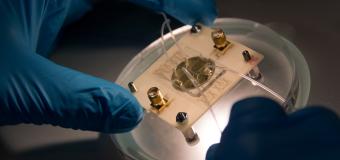
A travers deux études doctorales et grâce à des compétences dans les domaines des micro-capteurs chimiques et de la micro-fluidique l’équipe MINAMAS du département MN2S a réussi à réaliser un premier prototype de laboratoire miniaturisé sur silicium. Inspiré de la chromatographie en phase gazeuse, il permet l’analyse simultanée de traces de composés organiques volatils considérés comme des marqueurs chimiques du cancer du poumon.

Ces travaux publiés récemment dans le journal Sensors and Actuators B ont été rendus possibles grâce à des collaborations très fortes avec des chercheurs de l’ICB de Dijon et l’Institut Jean Lamour d’Epinal.

Contact : Jean-Baptiste Sanchez

  • Entrepreneurs-PhD Award : Second place for Vladimir Gauthier at the national level

    Awarded for his « CellSelect project » he proposes a robot capable of improving the precision and speed of cell sorting in the field of innovative therapies.

    His work is the result of research carried out of Biomedical Microrobotics Team of FEMTO-ST Institute.

    Read more
  • Jean-Antoine Seon : awarded with the 2nd national PHD prize in robotics

    Jean Antoine was distinguished on November 22th at the CNRS headquarters for his pioneer international work on a micro robotic dextral hand.

    Read more
  • Elodie Pahon is the award winner of "Hydrogen Europe Research young Scientist" in the transport field

    This award recognizes her high-level works that aim developping prognosis and smart control approaches dedicated to fuel cell systems. 
    Read more
  • Emmanuel RAMASSO, recipient of a « Group Achievement Award » by NASA

    For outstanding contributions to the open data initiative by conducting and posting experimental system fault and run-to-failure data sets with exceptional scientific value.

    Read more
  • Chimeras exist...

    The American Institute of Physics (AIP) has featured our recent article in a special science highlight, known as a Scilight. Due to its novelty and close connection with ever-present phenomena, reported results are of wide interest to the general public.

    Read more
  • Entrepreneurs-PhD Award in Bourgogne-Franche-Comté: 3 laureates from FEMTO-ST institute

    Vladimir Gauthier (CellSelect project), Aliyasin El Ayouch (Metabsorber project), Romain Viala (MICAD project),   were rewarded during the regional final which took place on October 16 in Dijon

    Read more
  • « Micron d’or » Award at the international microtechnology trade fair

    For one of the most dexterous miniature robots with 7 degrees of freedom, allowing micromanipulation and microassembly in extremely confined spaces

    Read more
  • Polymer-based nanowires

    Molecules, salt and light :  an easy recipe to provide giant nanowires !

    Read more
  • Discussions about good practices around smart specialization

    In the frame of the 2014-2020 programming of the European Regional Development Funds (ERDF), the European Union has asked all the regions of Europe to draw up a "Smart Specialization Strategy" for research and innovation on their own territory: this is the S3.

    Read more
  • Optical Neural Networks start to learn...

    Work is actively in progress at FEMTO-ST in order to design the photonic architectures dedicated to our future processors that will be computing through artificial intelligence concepts.

    Read more