
The institute
FEMTO's news

Grand Prix National de l'Ingénierie 2015

Sous l’égide des ministères de l’Écologie, de l’Économie, et du Logement, et en partenariat avec Syntec-Ingénierie et le Groupe Moniteur, le Grand Prix National de l'Ingénierie est venu récompenser jeudi 14 octobre à Paris les travaux du groupe Assystem (groupe international d’Ingénierie et de conseils en innovation) qui ont débouché, grâce à leur partenariat étroit avec les équipes de recherches de FEMTO-ST, au développement d’un moteur qui produit de l’énergie mécanique ou électrique à partir de la revalorisation de rejets thermiques d’origine quelconque (biomasse, chaleur fatale voire solaire).
Ce moteur innovant dans lequel aucun carburant n’est brûlé, peut ainsi s’intégrer dans un procédé industriel rejetant de la chaleur afin de la convertir en électricité mais également de valoriser la chaleur à l’échappement d’un véhicule pour diminuer sa consommation ou encore atteindre des hauts rendements dans les habitats, les bâtiments tertiaires…

Energine fonctionne sur le principe du cycle thermodynamique de type Ericsson. C’est un moteur alternatif à apport de chaleur externe, à enceintes de compression et de détente distinctes, à récupérateur et à fluide de travail monophasique gazeux (air, hélium). Ce cycle thermodynamique fonctionne suivant quatre transformations : deux isothermes et deux isobares. Il peut fonctionner en cycle ouvert avec ou sans récupérateur de chaleur, en cycle fermé avec récupérateur de chaleur. Il possède, tout comme le cycle de Stirling, un rendement maximal égal, en théorie, au rendement de Carnot dans le cas d’une récupération de chaleur parfaite.
La source thermique externe peut être quelconque : rejets industriels dont la température est supérieure à 150°C (gaz brûlés, fumées, combustion), l’énergie solaire, etc… D’autre part, c’est une machine silencieuse étant donné que l’apport de chaleur ne se fait pas sous la forme d’une combustion interne telle que dans les moteurs thermiques de type diesel ou à essence. Ce qui en fait également un moteur moins polluant.

Contacts :
Mathieu Doubs
François Lanzetta

  • Entrepreneurs-PhD Award : Second place for Vladimir Gauthier at the national level

    Awarded for his « CellSelect project » he proposes a robot capable of improving the precision and speed of cell sorting in the field of innovative therapies.

    His work is the result of research carried out of Biomedical Microrobotics Team of FEMTO-ST Institute.

    Read more
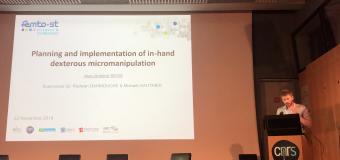
  • Jean-Antoine Seon : awarded with the 2nd national PHD prize in robotics

    Jean Antoine was distinguished on November 22th at the CNRS headquarters for his pioneer international work on a micro robotic dextral hand.

    Read more
  • Elodie Pahon is the award winner of "Hydrogen Europe Research young Scientist" in the transport field

    This award recognizes her high-level works that aim developping prognosis and smart control approaches dedicated to fuel cell systems. 
    Read more
  • Emmanuel RAMASSO, recipient of a « Group Achievement Award » by NASA

    For outstanding contributions to the open data initiative by conducting and posting experimental system fault and run-to-failure data sets with exceptional scientific value.

    Read more
  • Chimeras exist...

    The American Institute of Physics (AIP) has featured our recent article in a special science highlight, known as a Scilight. Due to its novelty and close connection with ever-present phenomena, reported results are of wide interest to the general public.

    Read more
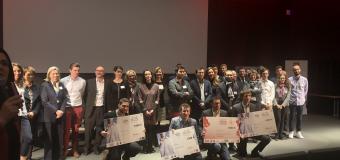
  • Entrepreneurs-PhD Award in Bourgogne-Franche-Comté: 3 laureates from FEMTO-ST institute

    Vladimir Gauthier (CellSelect project), Aliyasin El Ayouch (Metabsorber project), Romain Viala (MICAD project),   were rewarded during the regional final which took place on October 16 in Dijon

    Read more
  • « Micron d’or » Award at the international microtechnology trade fair

    For one of the most dexterous miniature robots with 7 degrees of freedom, allowing micromanipulation and microassembly in extremely confined spaces

    Read more
  • Polymer-based nanowires

    Molecules, salt and light :  an easy recipe to provide giant nanowires !

    Read more
  • Discussions about good practices around smart specialization

    In the frame of the 2014-2020 programming of the European Regional Development Funds (ERDF), the European Union has asked all the regions of Europe to draw up a "Smart Specialization Strategy" for research and innovation on their own territory: this is the S3.

    Read more
  • Optical Neural Networks start to learn...

    Work is actively in progress at FEMTO-ST in order to design the photonic architectures dedicated to our future processors that will be computing through artificial intelligence concepts.

    Read more