
The institute
FEMTO's news

Grand Prix National de l'Ingénierie 2015

Sous l’égide des ministères de l’Écologie, de l’Économie, et du Logement, et en partenariat avec Syntec-Ingénierie et le Groupe Moniteur, le Grand Prix National de l'Ingénierie est venu récompenser jeudi 14 octobre à Paris les travaux du groupe Assystem (groupe international d’Ingénierie et de conseils en innovation) qui ont débouché, grâce à leur partenariat étroit avec les équipes de recherches de FEMTO-ST, au développement d’un moteur qui produit de l’énergie mécanique ou électrique à partir de la revalorisation de rejets thermiques d’origine quelconque (biomasse, chaleur fatale voire solaire).
Ce moteur innovant dans lequel aucun carburant n’est brûlé, peut ainsi s’intégrer dans un procédé industriel rejetant de la chaleur afin de la convertir en électricité mais également de valoriser la chaleur à l’échappement d’un véhicule pour diminuer sa consommation ou encore atteindre des hauts rendements dans les habitats, les bâtiments tertiaires…

Energine fonctionne sur le principe du cycle thermodynamique de type Ericsson. C’est un moteur alternatif à apport de chaleur externe, à enceintes de compression et de détente distinctes, à récupérateur et à fluide de travail monophasique gazeux (air, hélium). Ce cycle thermodynamique fonctionne suivant quatre transformations : deux isothermes et deux isobares. Il peut fonctionner en cycle ouvert avec ou sans récupérateur de chaleur, en cycle fermé avec récupérateur de chaleur. Il possède, tout comme le cycle de Stirling, un rendement maximal égal, en théorie, au rendement de Carnot dans le cas d’une récupération de chaleur parfaite.
La source thermique externe peut être quelconque : rejets industriels dont la température est supérieure à 150°C (gaz brûlés, fumées, combustion), l’énergie solaire, etc… D’autre part, c’est une machine silencieuse étant donné que l’apport de chaleur ne se fait pas sous la forme d’une combustion interne telle que dans les moteurs thermiques de type diesel ou à essence. Ce qui en fait également un moteur moins polluant.

Contacts :
Mathieu Doubs
François Lanzetta
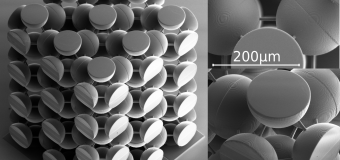
  • ThermoBot : micro robots that walk on water

    Imagine, a robot, the size of a fly, walking on the surface of the water and pursued by a laser beam. One could believe in a science fiction scenario...

    Read more
  • Recognizing liars from the sound of their voice ?

    Scientists have prouved that the intensity, speed and pitch of the speaker's voice automatically influences our perception of the reliability and honesty of his or her speech. This work is published in the prestigious journal "Nature Communications"

    Read more
  • European project for the development of sustainable and high-performance bio-based composites

    Led by FEMTO-ST and supported by the University of Franche-Comté, the « SSUCHY » R&D project which brings together 17 European partners is entering its final phase. The project is now quite advanced.

    Read more
  • Understanding the cytotoxicity of metallic nanoparticles

    A recent study published in the journal "Chemical Science" and involving FEMTO-ST gives new insights into the understanding of the mechanisms of DNA alteration in cells by metallic nanoparticles.

    Read more
  • Artificial intelligence for next-generation ultrafast photonics

    How can machine learning and associated methods improve the development of next-generation laser sources and revolutionize applications where ultrafast light plays a central role?

    Read more
  • Strong involvement of FEMTO-ST in the H2020 project "PhotonHub Europe"

    The objective of this project is to help European SMEs to increase their competitiveness through photonics with a online guidance, which will offer the support of 54 leading competence centers in Europe, including FEMTO-ST, which is also the scientific coordinator at the national level.

    Read more
  • First demonstration of self-confined nonlinear waves in plasmonic structures

    By providing the very first experimental evidence of the existence of this phenomenon, FEMTO-ST researchers and their partners hope to be able to generate this nonlinear effect using low intensity laser sources, in order to use it for nanophotonics applications.

    Read more
  • Mengjia Wang receives the « Chinese government award 2020 »

    As a PhD student of the Optics Department of FEMTO-ST , Mengjia Wang has been recognized by the Chinese Government for his outstanding work in the field of nanophotonics and plasmonics.

    Read more
  • Laurent LARGER named Fellow 2021 of OSA

    Full professor of Physics/Optics at the University of Franche-Comté and researcher at FEMTO-ST institute, Laurent Larger is rewarded for his pioneering work on nonlinear dynamics in optoelectronics and on the development of new architectures for photonic artificial intelligence.

    Read more
  • CNRS "Proof by Image" competition

     Discover the selection of the 20 images selected by the CNRS, one of which is presented by FEMTO-ST, and vote for the "audience award" photo.

    Read more