The institute
FEMTO's news

Des biopuces pour percer les mécanismes de développement des cancers

Les chimiothérapies à base de 5-fluoroUracile (5-FU) agissent sur la division cellulaire et peuvent ainsi interrompre la croissance tumorale, cependant l’efficacité ce ces drogues s’avère aujourd’hui limitée car le traitement induit la libération d’hormones du système immunitaire, en particulier les interleukines, qui favorisent l’apparition de nouvelles tumeurs. C’est «l’effet rebond ».

Elucider le mécanisme d’induction des interleukines sous chimiothérapie permettrait d’envisager de bloquer leurs actions et d’améliorer de façon significative l’efficacité du traitement au 5-FU.

Une avancée majeure vient d’être obtenue par l’équipe du Pr. François Ghiringhelli (Inserm Avenir, CGFL, Dijon) appuyé par le potentiel biopuce à résonance des plasmons de surface (SPR) présent au sein du département MN2S de FEMTO-ST (Bruchard et al., Nature Med, Jan 2013). C’est au travers d’une étude d’interaction biomoléculaire effectuée à partir de biopuces conçues et fabriquées au sein des plateformes MIMENTO et CLIPP qu’une interaction majeure entre deux protéines (cathepsine β et NLRP3) a été certifiée directe et spécifique. Cette reconnaissance permet ainsi la libération d’interleukine 1 à l’origine de l’effet rebond Ce mécanisme élucidé in vitro a permis d’engager des études sur le petit animal dépourvu de la voie de synthèse de l’interleukine 1 (IL-1). Les taux de guérison indiquent qu'une meilleure stratégie chimiothérapeutique sera à l’avenir de combiner l'inhibition del'IL-1 et un traitement au 5-FU.

Cet article vient d’être « highlighted » par l’éditeur en chef de Science Signaling (L. K. Ferrarelli, Chemotherapeutics Inflame Tumor Growth. Sci. Signal.6, ec12 (2013)) comme étude à très fort impact pour la compréhension de l’effet rebond (et les moyens de s’en prévenir) observé fréquemment en chimiothérapie.

Contact : Wilfrid Boireau (wilfrid.boireau@femto-st.fr)
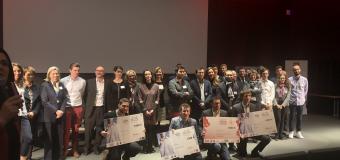
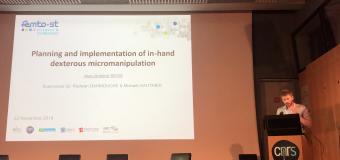
  • « Micron d’or » Award at the international microtechnology trade fair

    For one of the most dexterous miniature robots with 7 degrees of freedom, allowing micromanipulation and microassembly in extremely confined spaces

    Read more
  • Polymer-based nanowires

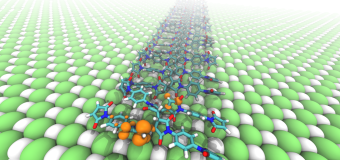
    Molecules, salt and light :  an easy recipe to provide giant nanowires !

    Read more
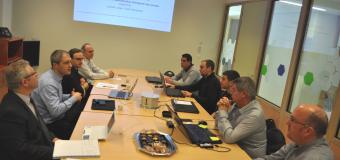
  • Discussions about good practices around smart specialization

    In the frame of the 2014-2020 programming of the European Regional Development Funds (ERDF), the European Union has asked all the regions of Europe to draw up a "Smart Specialization Strategy" for research and innovation on their own territory: this is the S3.

    Read more
  • Optical Neural Networks start to learn...

    Work is actively in progress at FEMTO-ST in order to design the photonic architectures dedicated to our future processors that will be computing through artificial intelligence concepts.

    Read more
  • FEMTO-ST remporte le 2e prix d'ActInSpace 2018 (Besançon)

    La troisième édition d'ActInSpace s’est déroulée en simultané dans plusieurs villes de France, d'Europe et du monde les 25 et 26 mai 2018.

    Read more
  • When the light is directed by its magnetic field

    FEMTO-ST researchers have discovered a new optical magnetic interaction to direct light fluxes. These works are published in the journal Light: Science and Applications
    Read more
  • Amar Nath Ghosh awarded at OSA Advanced Photonics Congress

    Amar Nath Ghosh won the Best student paper award of the OSA Advanced Photonics Congress , Zurich.

    Read more
  • L'équipe nanoscience de FEMTO-ST en couverture du journal de la société chimique de France

    Read more
  • Focus on the innovations of the "hydrogen-energy systems" sector

    A few days after the announcement by the government of the launch of a major national hydrogen plan, the Femto-ST institute is organizing on 20 June 2018 at the FCLAB in Belfort, a focus on innovations in the "hydrogen energy systems" sector.

    Read more
  • Robotic assembly of the smallest house in the world

    the handling and assembly capabilities of nanocomponents of the "μRobotex" platform make the buzz on the net and in the international press through the origami manufacturing of a micro-house at the end of an optical fiber whose dimensions are less than the diameter of a hair.

    Read more