
The institute
FEMTO's news

Des biopuces pour percer les mécanismes de développement des cancers

Les chimiothérapies à base de 5-fluoroUracile (5-FU) agissent sur la division cellulaire et peuvent ainsi interrompre la croissance tumorale, cependant l’efficacité ce ces drogues s’avère aujourd’hui limitée car le traitement induit la libération d’hormones du système immunitaire, en particulier les interleukines, qui favorisent l’apparition de nouvelles tumeurs. C’est «l’effet rebond ».

Elucider le mécanisme d’induction des interleukines sous chimiothérapie permettrait d’envisager de bloquer leurs actions et d’améliorer de façon significative l’efficacité du traitement au 5-FU.

Une avancée majeure vient d’être obtenue par l’équipe du Pr. François Ghiringhelli (Inserm Avenir, CGFL, Dijon) appuyé par le potentiel biopuce à résonance des plasmons de surface (SPR) présent au sein du département MN2S de FEMTO-ST (Bruchard et al., Nature Med, Jan 2013). C’est au travers d’une étude d’interaction biomoléculaire effectuée à partir de biopuces conçues et fabriquées au sein des plateformes MIMENTO et CLIPP qu’une interaction majeure entre deux protéines (cathepsine β et NLRP3) a été certifiée directe et spécifique. Cette reconnaissance permet ainsi la libération d’interleukine 1 à l’origine de l’effet rebond Ce mécanisme élucidé in vitro a permis d’engager des études sur le petit animal dépourvu de la voie de synthèse de l’interleukine 1 (IL-1). Les taux de guérison indiquent qu'une meilleure stratégie chimiothérapeutique sera à l’avenir de combiner l'inhibition del'IL-1 et un traitement au 5-FU.

Cet article vient d’être « highlighted » par l’éditeur en chef de Science Signaling (L. K. Ferrarelli, Chemotherapeutics Inflame Tumor Growth. Sci. Signal.6, ec12 (2013)) comme étude à très fort impact pour la compréhension de l’effet rebond (et les moyens de s’en prévenir) observé fréquemment en chimiothérapie.

Contact : Wilfrid Boireau (wilfrid.boireau@femto-st.fr)

  • FEMTO-ST is closed

    Within the framework of Coronavirus (COVID-19) epidemic and  following the measures announced by the President of the French Republic,  all the premises of our laboratory in Besançon, Belfort and Montbéliard cities are closed to the public from this Tuesday March 17.

    Read more
  • I-PhD Innovation Competition: 2 winners from FEMTO-ST

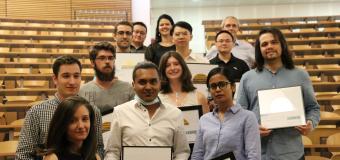
    Maya Geagea (ANIO-PAC project: micro fuel cells), and Gaël Matten (VIBISCUS project: noise reduction system), special jury prize, are winners of the 2019 innovation awards.

    Read more
  • Sarah Benchabane winner of an ERC Consolidator grant 2019

    CNRS Research Fellow at the FEMTO-ST Institute, Sarah is awarded with a prestigious €2M European Research Council (ERC) grant for her  project : Nanophonics for Quantum Information Processing.

    Read more
  • Stardust Odyssey : A new world record !

    Discover the smallest volume character ever animated in stop-motion (frame by frame) through a short film made thanks to FEMTO-ST's high-tech robotic equipments and researchers.

    Read more
  • Final report of the DATAZERO project

    A national project to design and manage medium power data centers powered exclusively by renewable energy sources

    Read more
  • Vladimir GAUTHIER is national winner of the PEPITE competition for young creators of innovative companies

    Entrepreneurial PhD at FEMTO-ST, Vladimir Gauthier is developing a company project on the microrobotic sorting of biological cells, which has received national price !

    Read more
  • Two young regional researchers awarded by the CNRS bronze medal

    Aude Bolopion (microrobotics) and Nadia Yousfi-Steiner (electrical engineering), two young researchers from FEMTO-ST Institute, were awarded by the CNRS bronze medal for their contribution to the advancement of French research.

    Read more
  • Secure and certify time

    Inauguration on Tuesday, July 9 of a joint laboratory between FEMTO-ST and Gorgy Timing to develop secure and certified time and frequency broadcasting systems for wireless and computer networks.

    Read more
  • Micro-soufflage de verre pour la réalisation de composants optiques miniatures

    A team of researchers from FEMTO-ST has developed miniature conical lenses by revisiting glass-blowing techniques practiced since Roman times.

    Read more
  • Detecting problems of the anti-bleeding system of patients in 60 minutes

    Researchers from FEMTO-ST institue and the Universitiy of Geneva  have developed an innovative device that investigates a patient’s platelet capacity in near real-life conditions so that bleeding can be stopped.

    Read more