
The institute
FEMTO's news

Des biopuces pour percer les mécanismes de développement des cancers

Les chimiothérapies à base de 5-fluoroUracile (5-FU) agissent sur la division cellulaire et peuvent ainsi interrompre la croissance tumorale, cependant l’efficacité ce ces drogues s’avère aujourd’hui limitée car le traitement induit la libération d’hormones du système immunitaire, en particulier les interleukines, qui favorisent l’apparition de nouvelles tumeurs. C’est «l’effet rebond ».

Elucider le mécanisme d’induction des interleukines sous chimiothérapie permettrait d’envisager de bloquer leurs actions et d’améliorer de façon significative l’efficacité du traitement au 5-FU.

Une avancée majeure vient d’être obtenue par l’équipe du Pr. François Ghiringhelli (Inserm Avenir, CGFL, Dijon) appuyé par le potentiel biopuce à résonance des plasmons de surface (SPR) présent au sein du département MN2S de FEMTO-ST (Bruchard et al., Nature Med, Jan 2013). C’est au travers d’une étude d’interaction biomoléculaire effectuée à partir de biopuces conçues et fabriquées au sein des plateformes MIMENTO et CLIPP qu’une interaction majeure entre deux protéines (cathepsine β et NLRP3) a été certifiée directe et spécifique. Cette reconnaissance permet ainsi la libération d’interleukine 1 à l’origine de l’effet rebond Ce mécanisme élucidé in vitro a permis d’engager des études sur le petit animal dépourvu de la voie de synthèse de l’interleukine 1 (IL-1). Les taux de guérison indiquent qu'une meilleure stratégie chimiothérapeutique sera à l’avenir de combiner l'inhibition del'IL-1 et un traitement au 5-FU.

Cet article vient d’être « highlighted » par l’éditeur en chef de Science Signaling (L. K. Ferrarelli, Chemotherapeutics Inflame Tumor Growth. Sci. Signal.6, ec12 (2013)) comme étude à très fort impact pour la compréhension de l’effet rebond (et les moyens de s’en prévenir) observé fréquemment en chimiothérapie.

Contact : Wilfrid Boireau (wilfrid.boireau@femto-st.fr)
  • ThermoBot : micro robots that walk on water

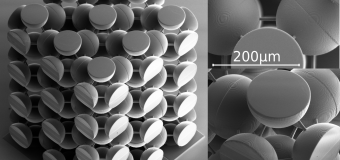
    Imagine, a robot, the size of a fly, walking on the surface of the water and pursued by a laser beam. One could believe in a science fiction scenario...

    Read more
  • Recognizing liars from the sound of their voice ?

    Scientists have prouved that the intensity, speed and pitch of the speaker's voice automatically influences our perception of the reliability and honesty of his or her speech. This work is published in the prestigious journal "Nature Communications"

    Read more
  • European project for the development of sustainable and high-performance bio-based composites

    Led by FEMTO-ST and supported by the University of Franche-Comté, the « SSUCHY » R&D project which brings together 17 European partners is entering its final phase. The project is now quite advanced.

    Read more
  • Understanding the cytotoxicity of metallic nanoparticles

    A recent study published in the journal "Chemical Science" and involving FEMTO-ST gives new insights into the understanding of the mechanisms of DNA alteration in cells by metallic nanoparticles.

    Read more
  • Artificial intelligence for next-generation ultrafast photonics

    How can machine learning and associated methods improve the development of next-generation laser sources and revolutionize applications where ultrafast light plays a central role?

    Read more
  • Strong involvement of FEMTO-ST in the H2020 project "PhotonHub Europe"

    The objective of this project is to help European SMEs to increase their competitiveness through photonics with a online guidance, which will offer the support of 54 leading competence centers in Europe, including FEMTO-ST, which is also the scientific coordinator at the national level.

    Read more
  • First demonstration of self-confined nonlinear waves in plasmonic structures

    By providing the very first experimental evidence of the existence of this phenomenon, FEMTO-ST researchers and their partners hope to be able to generate this nonlinear effect using low intensity laser sources, in order to use it for nanophotonics applications.

    Read more
  • Mengjia Wang receives the « Chinese government award 2020 »

    As a PhD student of the Optics Department of FEMTO-ST , Mengjia Wang has been recognized by the Chinese Government for his outstanding work in the field of nanophotonics and plasmonics.

    Read more
  • Laurent LARGER named Fellow 2021 of OSA

    Full professor of Physics/Optics at the University of Franche-Comté and researcher at FEMTO-ST institute, Laurent Larger is rewarded for his pioneering work on nonlinear dynamics in optoelectronics and on the development of new architectures for photonic artificial intelligence.

    Read more
  • CNRS "Proof by Image" competition

     Discover the selection of the 20 images selected by the CNRS, one of which is presented by FEMTO-ST, and vote for the "audience award" photo.

    Read more