
The institute
FEMTO's news

Le projet ANR NEMRO mis en lumière par IEEE Spectrum !

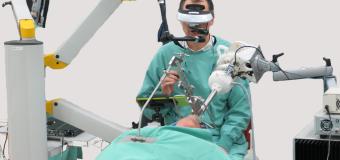
Une partie du projet ANR NEMRO, présenté par Cédric Girerd (doctorant FEMTO-ST / ICube)

lors de la conférence IEEE/RSJ International Conference on Intelligent Robots and Systems (IROS 2017)

est mise en avant dans IEEE Spectrum "The Most Cringe-Inducing Surgical Robots from IEEE's Intelligent Robots Conference"

https://spectrum.ieee.org/the-human-os/biomedical/devices/the-most-cringe-inducing-surgical-robots-from-ieees-intelligent-robots-conference

Visionnez la vidéo n°2. "Nasal cavity torture tool" pour en savoir plus !

Pour rappel, voici les défis de l’ANR - NEMRO (1)
Le projet ANR NEMRO traite de la relation entre les maladies neurodégénératives et la déficience olfactive. Plusieurs études cliniques récentes (souvent statistiques) ont démontré qu’il existe une corrélation entre la perte de l’odorat et l’apparition de ces pathologies. Le déficit olfactif est un signe précurseur "fiable" de la dégénérescence neuronale. Malgrécette avancée considérable dans la compréhension de certaines maladiesneurodégénératives et apparentées, peu de travaux scientifiques ambitieux permettant de comprendre l’origine, l’évolution et d’éventuels
moyens d’inverser la tendance de ces maladies par des thérapies ciblées.

Les partenaires du projet NEMRO : FEMTO-ST LMB, CHRUB/CIC-IT (Besançon) et ICUBE (Strasbourg) projettent de développer un endoscope nasal équipé d’un système d’imagerie OCT fibré (Optical Coherence Tomography). Ce dispositif consiste en un système robotique miniature (le diamètre est inférieur à 2mm) et flexible. La conception du robot repose sur l’utilisation d’un actionnement hybride : actionnement déporté assuré par un système mécatronique spécifique et un actionnement embarqué fondé sur l’utilisation de matériaux électroactifs (polymères électroactifs). L'endoscope microrobotisé constituera en un moyen de caractérisation dynamique in-vivo et non-invasif permettant d’effectuer des images 3D à haute résolution (biopsies optiques 3D). Ces dernières permettront d’analyser de manière très précise et en profondeur l’aspect et la texture des cellules olfactives comparables à des coupes histologiques.

À court terme, ce système donnera un moyen inédit d’investigation expérimental et à coût réduit de compréhension et de diagnostic de certaines maladies neurodégénératives ou apparentées. Il permettra également le suivi de l’évolution, dans le temps, de la perte d’odorat et sa répercussion sur la dégénérescence neuronale.

(1) PROJET ANR NEMRO : (2015-2019) piloté par de département AS2M de l'institut FEMTO-ST
coordinateur : Brahim TAMADAZTE, Chargé de Recherche CNRS
  • New platform to support the design and optimization of fuel cell hybride system and battery

    Virtual FCS" is the first freely accessible online simulation platform to support fuel cell manufacturers and users.

     Supported by a European funding, "Virtual FCS" has for French partner the University of Bourgogne-Franche-Comté through the FEMTO-ST institute and the FC-LAB

    Read more
  • ThermoBot : micro robots that walk on water

    Imagine, a robot, the size of a fly, walking on the surface of the water and pursued by a laser beam. One could believe in a science fiction scenario...

    Read more
  • Recognizing liars from the sound of their voice ?

    Scientists have prouved that the intensity, speed and pitch of the speaker's voice automatically influences our perception of the reliability and honesty of his or her speech. This work is published in the prestigious journal "Nature Communications"

    Read more
  • European project for the development of sustainable and high-performance bio-based composites

    Led by FEMTO-ST and supported by the University of Franche-Comté, the « SSUCHY » R&D project which brings together 17 European partners is entering its final phase. The project is now quite advanced.

    Read more
  • Understanding the cytotoxicity of metallic nanoparticles

    A recent study published in the journal "Chemical Science" and involving FEMTO-ST gives new insights into the understanding of the mechanisms of DNA alteration in cells by metallic nanoparticles.

    Read more
  • Artificial intelligence for next-generation ultrafast photonics

    How can machine learning and associated methods improve the development of next-generation laser sources and revolutionize applications where ultrafast light plays a central role?

    Read more
  • Strong involvement of FEMTO-ST in the H2020 project "PhotonHub Europe"

    The objective of this project is to help European SMEs to increase their competitiveness through photonics with a online guidance, which will offer the support of 54 leading competence centers in Europe, including FEMTO-ST, which is also the scientific coordinator at the national level.

    Read more
  • First demonstration of self-confined nonlinear waves in plasmonic structures

    By providing the very first experimental evidence of the existence of this phenomenon, FEMTO-ST researchers and their partners hope to be able to generate this nonlinear effect using low intensity laser sources, in order to use it for nanophotonics applications.

    Read more
  • Mengjia Wang receives the « Chinese government award 2020 »

    As a PhD student of the Optics Department of FEMTO-ST , Mengjia Wang has been recognized by the Chinese Government for his outstanding work in the field of nanophotonics and plasmonics.

    Read more
  • Laurent LARGER named Fellow 2021 of OSA

    Full professor of Physics/Optics at the University of Franche-Comté and researcher at FEMTO-ST institute, Laurent Larger is rewarded for his pioneering work on nonlinear dynamics in optoelectronics and on the development of new architectures for photonic artificial intelligence.

    Read more