
The institute
FEMTO's news

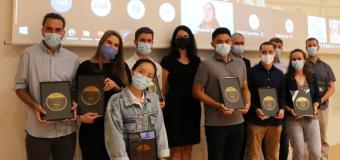
Bilal KOMATI (AS2M) obtient le Prix de la meilleure thèse en robotique

Depuis 2007, le GdR Robotique délivre un prix de thèse qui a pour but de distinguer de jeunes chercheurs en robotique dont les travaux, d’une grande qualité scientifique, ont permis une avancée de la recherche par des contributions au progrès des connaissances scientifiques et/ou aux innovations techniques en robotique.
L’édition 2015 concerne des thèses soutenues durant l'année 2014.

Félicitations à Bilal KOMATI (AS2M) qui a obtenu ce prix pour sa thèse intitulée : "Micro-assemblage automatisé à l’aide d’une pince instrumentée en force et d’une commande hybride force/position"

Le contexte général de la thèse est de développer des stratégies et des outils microrobotiques pour pouvoir assembler d'une manière automatisée des composants à l'échelle dimensionnelle du micromonde (typiquement entre un micromètre et un millimètre). Ces outils microrobotiques permettent de manipuler des objets artificiels ou biologiques (cellules vivantes, ADN, etc). Il faut savoir qu'à cette échelle, les composants sont quasiment invisibles à l'œil nu, on ne peut pas sentir ce qui se passe et on constate une inversion de l'importance des forces : les forces surfaciques (capillarité, van der Waals, électrostatiques) deviennent prépondérantes par rapport aux forces volumiques (poids, inertie). Ainsi, un exemple simple rencontré dans la nature illustrant la prépondérance des forces surfaciques est les petits insectes qui arrivent à grimper sur le mur sans tomber malgré leur poids. Il est ainsi nécessaire et indispensable de mettre en œuvre des stratégies novatrices appropriées pour ces microsystèmes.
Pour répondre à cette difficulté de sentir dans le micromonde, on a proposé d’intégrer des capteurs de force dans une micropince (à base de deux doigts actionnés par effet piézoélectrique). Le but des capteurs sera de fournir un retour tactile similaire à celui de l’homme quand il touche des composants. Ces capteurs de force vont permettre de mesurer les forces appliquées par la pince de chaque côté de l'objet afin de maîtriser sa manipulation. La pince ainsi développée sera nommée une pince instrumentée en force. L’objectif final de la thèse étant d’automatiser le micro-assemblage, nous avons développé des stratégies de micro-assemblage et des lois de commande adaptés aux spécificités du micromonde pour commander la station robotique de micro-assemblage (inclus la pince instrumentée en force). La loi de commande proposée permet de positionner le composant dans sa position désirée tout en commandant les forces d’interaction entre les différents composants.

Encadrants : Philippe LUTZ et Cédric CLEVY

pince instrumentée

pince instrumentée

Pince instrumentée en force (crédit photo : Ludovic Godard).
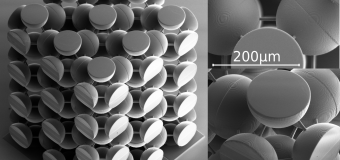
  • ThermoBot : micro robots that walk on water

    Imagine, a robot, the size of a fly, walking on the surface of the water and pursued by a laser beam. One could believe in a science fiction scenario...

    Read more
  • Recognizing liars from the sound of their voice ?

    Scientists have prouved that the intensity, speed and pitch of the speaker's voice automatically influences our perception of the reliability and honesty of his or her speech. This work is published in the prestigious journal "Nature Communications"

    Read more
  • European project for the development of sustainable and high-performance bio-based composites

    Led by FEMTO-ST and supported by the University of Franche-Comté, the « SSUCHY » R&D project which brings together 17 European partners is entering its final phase. The project is now quite advanced.

    Read more
  • Understanding the cytotoxicity of metallic nanoparticles

    A recent study published in the journal "Chemical Science" and involving FEMTO-ST gives new insights into the understanding of the mechanisms of DNA alteration in cells by metallic nanoparticles.

    Read more
  • Artificial intelligence for next-generation ultrafast photonics

    How can machine learning and associated methods improve the development of next-generation laser sources and revolutionize applications where ultrafast light plays a central role?

    Read more
  • Strong involvement of FEMTO-ST in the H2020 project "PhotonHub Europe"

    The objective of this project is to help European SMEs to increase their competitiveness through photonics with a online guidance, which will offer the support of 54 leading competence centers in Europe, including FEMTO-ST, which is also the scientific coordinator at the national level.

    Read more
  • First demonstration of self-confined nonlinear waves in plasmonic structures

    By providing the very first experimental evidence of the existence of this phenomenon, FEMTO-ST researchers and their partners hope to be able to generate this nonlinear effect using low intensity laser sources, in order to use it for nanophotonics applications.

    Read more
  • Mengjia Wang receives the « Chinese government award 2020 »

    As a PhD student of the Optics Department of FEMTO-ST , Mengjia Wang has been recognized by the Chinese Government for his outstanding work in the field of nanophotonics and plasmonics.

    Read more
  • Laurent LARGER named Fellow 2021 of OSA

    Full professor of Physics/Optics at the University of Franche-Comté and researcher at FEMTO-ST institute, Laurent Larger is rewarded for his pioneering work on nonlinear dynamics in optoelectronics and on the development of new architectures for photonic artificial intelligence.

    Read more
  • CNRS "Proof by Image" competition

     Discover the selection of the 20 images selected by the CNRS, one of which is presented by FEMTO-ST, and vote for the "audience award" photo.

    Read more