
The institute
FEMTO's news

Congrès CETSIS - 27-29 octobre 2014

Besançon accueille le congrès CETSIS 2014 (Colloque sur l'Enseignement des Technologies et des Sciences de l'Information et des Systèmes) du 27 au 29 octobre 2014. Ce colloque se déroule essentiellement autour de démonstrations réelles de travaux pratiques et de projets (maquettes de démonstration, posters, matériels mis en œuvre). Des tables rondes sont prévues autour des micro-nanotechnologies, des véhicules et énergies du futur, des relations industrie – recherche et de la pédagogie innovante.

Des enseignants, enseignants-chercheurs, doctorants, industriels de toute la France mais aussi des pays francophones échangeront sur l’évolution des pratiques pédagogiques. Les thèmes abordés mettront en avant la pluridisciplinarité constituée d’une association équilibrée entre sciences de l’ingénieur et sciences et technologies de l’information et des systèmes. L’institut pluridisciplinaire FEMTO-ST qui prône les liens formation–recherche soutient cet évènement auxquels participent activement un grand nombre de ses membres. Ce colloque est par ailleurs soutenu par les associations de mécanique (AFM), de physique (SFP), d’optique (SFO) et d’électronique (club EEA).

Vous pouvez encore vous inscrire !

Site du congrès

http://cetsis2014.sciencesconf.org/

Contacts

Fabrice Sthal , fsthal@ens2m.fr, 03 81 40 28 31

Thérèse Leblois, therese.leblois@univ-fcomte.fr, 03 63 08 24 56

cetsis2013pomme

cetsis2013pomme

cetsis2013pomme
  • An innovative solution to detect pollutants in the subsoil

    Researchers from FEMTO-STinstitute and the company TOTAL SA have succeeded in detecting organic pollutants with methods that did not require sampling and have been able to monitor the evolution of the pollution of the subsoil over periods ranging up to several years.

    Read more
  • FEMTO-ST is closed

    Within the framework of Coronavirus (COVID-19) epidemic and  following the measures announced by the President of the French Republic,  all the premises of our laboratory in Besançon, Belfort and Montbéliard cities are closed to the public from this Tuesday March 17.

    Read more
  • I-PhD Innovation Competition: 2 winners from FEMTO-ST

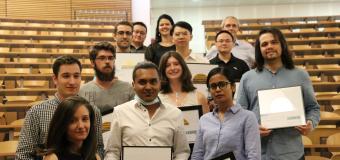
    Maya Geagea (ANIO-PAC project: micro fuel cells), and Gaël Matten (VIBISCUS project: noise reduction system), special jury prize, are winners of the 2019 innovation awards.

    Read more
  • Sarah Benchabane winner of an ERC Consolidator grant 2019

    CNRS Research Fellow at the FEMTO-ST Institute, Sarah is awarded with a prestigious €2M European Research Council (ERC) grant for her  project : Nanophonics for Quantum Information Processing.

    Read more
  • Stardust Odyssey : A new world record !

    Discover the smallest volume character ever animated in stop-motion (frame by frame) through a short film made thanks to FEMTO-ST's high-tech robotic equipments and researchers.

    Read more
  • Final report of the DATAZERO project

    A national project to design and manage medium power data centers powered exclusively by renewable energy sources

    Read more
  • Vladimir GAUTHIER is national winner of the PEPITE competition for young creators of innovative companies

    Entrepreneurial PhD at FEMTO-ST, Vladimir Gauthier is developing a company project on the microrobotic sorting of biological cells, which has received national price !

    Read more
  • Two young regional researchers awarded by the CNRS bronze medal

    Aude Bolopion (microrobotics) and Nadia Yousfi-Steiner (electrical engineering), two young researchers from FEMTO-ST Institute, were awarded by the CNRS bronze medal for their contribution to the advancement of French research.

    Read more
  • Secure and certify time

    Inauguration on Tuesday, July 9 of a joint laboratory between FEMTO-ST and Gorgy Timing to develop secure and certified time and frequency broadcasting systems for wireless and computer networks.

    Read more
  • Micro-soufflage de verre pour la réalisation de composants optiques miniatures

    A team of researchers from FEMTO-ST has developed miniature conical lenses by revisiting glass-blowing techniques practiced since Roman times.

    Read more