
Collaboration renforcée avec le CNES en tribologie spatiale
FEMTO-ST et le CNES unissent leurs expertises pour développer les lubrifiants des futures applications spatiales dans des conditions extrêmes.
Depuis 2018, l’Institut FEMTO-ST et le Centre National des Études Spatiales (CNES) collaborent activement. Ainsi, nos collaborations ont permis de :
- Développer de nouvelles générations de lubrifiants fluides [1] et solides [2,3]
- Réaliser des expertises suite à des anomalies mécanismes [4].
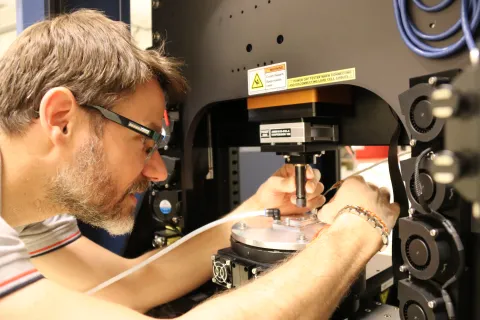
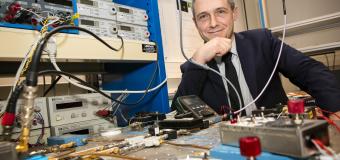
Afin de pérenniser la recherche française en tribologie spatiale, le CNES a mis à disposition de l’institut deux tribomètres. Ces équipements permettent d’étudier le frottement, l’usure, et la lubrification dans des conditions variées, avec des cinématiques et des environnements contrôlés. Les paramètres suivants peuvent ainsi être ajustés :
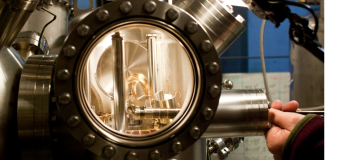
- La pression, allant du vide extrême (10−7 mbar) à la pression atmosphérique.
- La température, entre -120°C et +400°C.
- La composition de l’atmosphère et l’humidité.
Couplés aux instruments d’analyse de l’institut, le CNES et le FEMTO-ST unissent leurs compétences pour développer les lubrifiants (solides et fluides) des futures applications spatiales.
Grâce à cette collaboration renforcée, nous sommes désormais capables de relever de nouveaux défis scientifiques et technologiques. L’étude de l’effet de la composition des atmosphères, dans tous les environnements allant la pression atmosphérique au vide « pollué » par le dégazage des satellites en est un parfait exemple. Les variations thermiques également pilotables, permettent ainsi de recréer un environnement satellite au plus proches des conditions réelles (orbite très basse, astres et satellites naturels, etc.)
Plusieurs projets bénéficient déjà de ces équipements : la montée en maturité technologique d’un lubrifiant breveté conjointement par le CNES, le CNRS, le LaMCoS, et le LIST ; une thèse sur l’effet de la composition de l’environnement sur le comportement en frottement du MoS2 (cofinancement CNES/ADR Alcen).
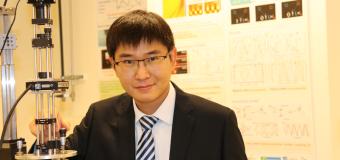
Accès aux équipements : Ces outils sont ouverts à tous types de développements. Ils sont mis à disposition de la communauté (laboratoires, industries) via des accords et des projets de recherche. Pour toute demande d’information, veuillez contacter le référent local : Guillaume COLAS, Chargé de recherche CNRS.
[1] M. Lambert, L. Rougeau, M. Petit, S. Carbillet, A. Pagnoux, J. Laporte, G. Colas, J. Sicre, Tribological Performance of Gelled Oils for Space Mechanisms Lubrication, in: 20th ESMATS, 2023. https://www.esmats.eu/esmatspapers/pastpapers/pdfs/2023/lambert.pdf.
[2] P. Serles, E. Nicholson, J. Tam, N. Barri, J.B. Chemin, G. Wang, Y. Michel, C.V. Singh, P. Choquet, A. Saulot, T. Filleter, G. Colas, High Performance Space Lubrication of MoS2 with Tantalum, Adv. Funct. Mater. 2110429 (2022) 1–10. https://doi.org/10.1002/adfm.202110429.
[3] G. Colas, R. Nabha, A. Rémi, X. Roizard, F. Lallemand, S. Margueron, J. Fontaine, J. Galipaud, J. Sicre, Lubrication by Self-Assembled Multilayer _ New Avenue For Low Cost Lubrication Alternative to MoS2, in: 21st ESMATS, 2025: pp. 2–7. https://www.esmats.eu/esmatspapers/pastpapers/pdfs/2025/colas_v2.pdf.
[4] G. Colas, R. Petre-bordenave, Y. Michel, P. Cornuault, Freting Wear Anomaly of Final CubeSat Ejection Tests : Expertise , Solution Testing ,and Lessons Learnt, in: 20th ESMATS, 2023. https://www.esmats.eu/esmatspapers/pastpapers/pdfs/2023/colas.pdf.





-

INGÉNIERIE
Sciences informatiques