

Enhanced collaboration with CNES in space tribology
FEMTO-ST and CNES are combining their expertise to develop lubricants for future space applications under extreme conditions.
Since 2018, the FEMTO-ST Institute and the French National Centre for Space Studies (CNES) have been actively collaborating. Our collaboration has enabled us to :
- Develop new generations of liquid [1] and solid [2,3] lubricants
- ].Conduct investigations following mechanical failures [4].
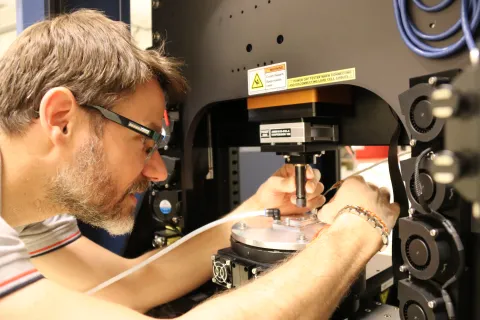
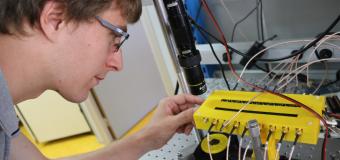
To ensure the long-term viability of French research in space tribology, CNES has provided the institute with two tribometers.
This equipment allows for the study of friction, wear, and lubrication under various conditions, with controlled kinematics and environments. The following parameters can thus be adjusted :
- Pressure, ranging from extreme vacuum (10−7 mbar) to atmospheric pressure.
- Temperature, between -120°C and +400°C.
- Atmospheric composition and humidity.
Working in conjunction with the institute’s analytical instruments, CNES and FEMTO-ST are pooling their expertise to develop lubricants (both solid and fluid) for future space applications.
Thanks to this strengthened collaboration, we are now able to tackle new scientific and technological challenges. Studying the effect of atmospheric composition across all environments—from atmospheric pressure to a vacuum “polluted” by satellite outgassing—is a perfect example. Controllable thermal variations also make it possible to recreate a satellite environment that closely mimics real-world conditions (very low Earth orbit, celestial bodies, and natural satellites, etc.).
Several projects are already benefiting from this equipment : the technological maturation of a lubricant jointly patented by CNES, CNRS, LaMCoS, and LIST; a thesis on the effect of environmental composition on the friction behavior of MoS2 (co-funded by CNES and ADR Alcen).
Access to equipment: These tools are available for all types of research and development. They are made available to the research community (laboratories, industry) through agreements and research projects. For further information, please contact the local representativel : Guillaume COLAS, Chargé de recherche CNRS.
[1] M. Lambert, L. Rougeau, M. Petit, S. Carbillet, A. Pagnoux, J. Laporte, G. Colas, J. Sicre, Tribological Performance of Gelled Oils for Space Mechanisms Lubrication, in: 20th ESMATS, 2023. https://www.esmats.eu/esmatspapers/pastpapers/pdfs/2023/lambert.pdf.
[2] P. Serles, E. Nicholson, J. Tam, N. Barri, J.B. Chemin, G. Wang, Y. Michel, C.V. Singh, P. Choquet, A. Saulot, T. Filleter, G. Colas, High Performance Space Lubrication of MoS2 with Tantalum, Adv. Funct. Mater. 2110429 (2022) 1–10. https://doi.org/10.1002/adfm.202110429.
[3] G. Colas, R. Nabha, A. Rémi, X. Roizard, F. Lallemand, S. Margueron, J. Fontaine, J. Galipaud, J. Sicre, Lubrication by Self-Assembled Multilayer _ New Avenue For Low Cost Lubrication Alternative to MoS2, in: 21st ESMATS, 2025: pp. 2–7. https://www.esmats.eu/esmatspapers/pastpapers/pdfs/2025/colas_v2.pdf.
[4] G. Colas, R. Petre-bordenave, Y. Michel, P. Cornuault, Freting Wear Anomaly of Final CubeSat Ejection Tests : Expertise , Solution Testing ,and Lessons Learnt, in: 20th ESMATS, 2023. https://www.esmats.eu/esmatspapers/pastpapers/pdfs/2023/colas.pdf.






-

INGÉNIERIE
Sciences informatiques

