
The institute
FEMTO's news

Métamatériau en torsion…en couverture de Science !

Muamer Kadic, enseignant-chercheur de l'Université Bourgogne Franche-Comté au sein du l’institut FEMTO-ST, est co-auteur d’un article dans la prestigieuse revue Science [1] en collaboration avec des partenaires du Karlsruhe Institute of Technology (KIT) en Allemagne. Leur découverte sur des métamatériaux mécaniques permettant de convertir une simple pression linéaire en un mouvement de torsion pure fait même l’objet de la couverture du journal [2].

Image Tobias Frenkel

Image Tobias Frenkel

Image Tobias Frenkel

Les métamatériaux constituent depuis un peu plus de 10 ans un sujet de recherche intensive dans de nombreux domaines de la physique (photonique, électromagnétisme, thermique, biochimie, acoustique, mécanique, sismique…). Ces milieux composites sont artificiellement structurés, le plus souvent périodiquement, à une échelle dimensionnelle inférieure à la longueur d’onde caractéristique du phénomène à contrôler (soit typiquement de la dizaine de nanomètres à plusieurs mètres selon le domaine considéré). Leur immense attrait vient de leur capacité à conférer aux “matériaux” qu’ils constituent des propriétés inédites, voire spectaculaires, impossibles à obtenir à partir des matériaux “continus” naturels, telles que l’invisibilité optique ou sismique par exemple.
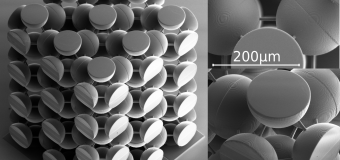
La découverte publiée dans Science repose sur des métamatériaux mécaniques dits « chiraux » : tout comme la main humaine, leurs motifs, bien qu’identiques, ne peuvent pas se superposer à leur image dans un miroir par absence de symétrie. Le métamatériau chiral conçu par Muamer Kadic et ses collègues, fabriqué grâce à une technologie innovante d’impression laser 3D de précision micrométrique, est alors capable de se tordre au lieu de se comprimer sous l’effet d’une contrainte uniaxiale (purement “rectiligne”) qui lui est appliquée. Ce comportement, totalement inédit, est proscrit par les règles usuelles de la mécanique continue dans un matériau standard. Cette nouvelle propriété de chiralité mécanique s’ajoute de surcroît à d’autres fonctionnalités propres à ce métamatériau pour lequel l’effet de taille relative est primordial [3], telles que l’allégement structurel et l’accroissement de rigidité. Protéger des objets d’ondes mécaniques indésirables pourrait en être une application potentielle.
Ces travaux ont été soutenus par le Labex ACTION et par l’ISITE Bourgogne Franche-Comté

.
[1] Tobias Frenzel, Muamer Kadic & Martin Wegener, “Three-dimensional mechanical metamaterials with a twist”, Science 358, 1072-1074 (2017). http://science.sciencemag.org/content/358/6366/1072
[2] http://science.sciencemag.org/content/358/6366
[3] Muamer Kadic, Tobias Frenzel & Martin Wegener, “Mechanical metamaterials: When size matters”, Nature Physics 14, 8–9 (2018)
  • ThermoBot : micro robots that walk on water

    Imagine, a robot, the size of a fly, walking on the surface of the water and pursued by a laser beam. One could believe in a science fiction scenario...

    Read more
  • Recognizing liars from the sound of their voice ?

    Scientists have prouved that the intensity, speed and pitch of the speaker's voice automatically influences our perception of the reliability and honesty of his or her speech. This work is published in the prestigious journal "Nature Communications"

    Read more
  • European project for the development of sustainable and high-performance bio-based composites

    Led by FEMTO-ST and supported by the University of Franche-Comté, the « SSUCHY » R&D project which brings together 17 European partners is entering its final phase. The project is now quite advanced.

    Read more
  • Understanding the cytotoxicity of metallic nanoparticles

    A recent study published in the journal "Chemical Science" and involving FEMTO-ST gives new insights into the understanding of the mechanisms of DNA alteration in cells by metallic nanoparticles.

    Read more
  • Artificial intelligence for next-generation ultrafast photonics

    How can machine learning and associated methods improve the development of next-generation laser sources and revolutionize applications where ultrafast light plays a central role?

    Read more
  • Strong involvement of FEMTO-ST in the H2020 project "PhotonHub Europe"

    The objective of this project is to help European SMEs to increase their competitiveness through photonics with a online guidance, which will offer the support of 54 leading competence centers in Europe, including FEMTO-ST, which is also the scientific coordinator at the national level.

    Read more
  • First demonstration of self-confined nonlinear waves in plasmonic structures

    By providing the very first experimental evidence of the existence of this phenomenon, FEMTO-ST researchers and their partners hope to be able to generate this nonlinear effect using low intensity laser sources, in order to use it for nanophotonics applications.

    Read more
  • Mengjia Wang receives the « Chinese government award 2020 »

    As a PhD student of the Optics Department of FEMTO-ST , Mengjia Wang has been recognized by the Chinese Government for his outstanding work in the field of nanophotonics and plasmonics.

    Read more
  • Laurent LARGER named Fellow 2021 of OSA

    Full professor of Physics/Optics at the University of Franche-Comté and researcher at FEMTO-ST institute, Laurent Larger is rewarded for his pioneering work on nonlinear dynamics in optoelectronics and on the development of new architectures for photonic artificial intelligence.

    Read more
  • CNRS "Proof by Image" competition

     Discover the selection of the 20 images selected by the CNRS, one of which is presented by FEMTO-ST, and vote for the "audience award" photo.

    Read more