
The institute
FEMTO's news

Current Biology publie les observations par AFM des microtubules réalisées par C. Elie-Caille

Les microtubules sont des polymères protéiques appartenant au cytosquelette et peuvent être assimilés à des « rails » sur lesquels se déplacent les chromosomes avant la division cellulaire.

Les microtubules sont présents en équilibre dynamique : ils se polymérisent et se dépolymérisent en permanence. Cette dynamique repose sur l’hydrolyse du GTP garnissant les microtubules, qui fragilise la structure du microtubule en induisant une courbure de ses protofilaments constitutifs.

Comprendre le fonctionnement de ces macromolécules protéiques, dans leur ensemble (microtubules) ou au niveau de leurs entités constitutives (protofilaments) permettrait d’appréhender les phénomènes de division cellulaire dans le cas particulier des phénomènes de cancérisation.

C. Elie-Caille a ainsi montré dans Current Biology (Impact factor 11) que la microscopie à force atomique (AFM) permet d’imager des protofilaments individuels de tubuline dans leur environnement natif, à une résolution moléculaire. Ses travaux ont tout d’abord confirmé par cette approche l’effet de l’hydrolyse du GTP et d’une kinésine (MCAK) sur la conformation des protofilaments de tubuline. Elle a ensuite montré que le taxol, molécule anticancéreuse, stabilise les microtubules par « rigidification » des protofilaments, ralentissant leur transition conformationnelle « Droite à courbée ».

Ces résultats ont fait la couverture du journal.

C. Elie-Caille et al, Current Biology (2007), 17, 1765-1770, "Straight GDP-Tubulin Protofilaments Form in the Presence of Taxol".

Images AFM de protofilaments de tubuline

Images AFM de protofilaments de tubuline
Images AFM de protofilaments de tubuline
  • Giacomo Clementi, grand prize i-PhD

    For his work on Lithium Niobate (LiNbO3), which has led to the design of original and efficient devices for the recovery of vibratory energy by the piezoelectric effect, in particular for connected objects.

    Read more
  • Concours des doctorants-ambassadeurs FEMTO-ST

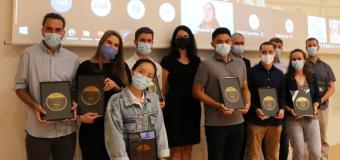
     Remise de prix aux trois vainqueurs du concours de meilleurs posters de présentation de travaux de thèse lors du séminaire interne FEMTO-ST du 2 juillet.

    Read more
  • Understanding energy transfers during photosynthesis

    Using three pigments manipulated by scanning tunneling microscopy, researchers from IPCMS and FEMTO-ST are studying energy transfers between molecules to gain a finer understanding of the photosynthesis mechanism in plants. This work is published in Nature Chemistry.

    Read more
  • International Day of Light on May 16th

    This year, the Student Chapter of FEMTO-ST organizes on this occasion a photo contest on the theme ′′ Light phenomena in everyday life ".

    Read more
  • AMAROB labelled Deep Tech company

    Spin off of FEMTO-ST, Amarob technologie has received the Deep Tech company label awarded by Bpifrance.

    Read more
  • New platform to support the design and optimization of fuel cell hybride system and battery

    Virtual FCS" is the first freely accessible online simulation platform to support fuel cell manufacturers and users.

     Supported by a European funding, "Virtual FCS" has for French partner the University of Bourgogne-Franche-Comté through the FEMTO-ST institute and the FC-LAB

    Read more
  • ThermoBot : micro robots that walk on water

    Imagine, a robot, the size of a fly, walking on the surface of the water and pursued by a laser beam. One could believe in a science fiction scenario...

    Read more
  • Recognizing liars from the sound of their voice ?

    Scientists have prouved that the intensity, speed and pitch of the speaker's voice automatically influences our perception of the reliability and honesty of his or her speech. This work is published in the prestigious journal "Nature Communications"

    Read more
  • European project for the development of sustainable and high-performance bio-based composites

    Led by FEMTO-ST and supported by the University of Franche-Comté, the « SSUCHY » R&D project which brings together 17 European partners is entering its final phase. The project is now quite advanced.

    Read more
  • Understanding the cytotoxicity of metallic nanoparticles

    A recent study published in the journal "Chemical Science" and involving FEMTO-ST gives new insights into the understanding of the mechanisms of DNA alteration in cells by metallic nanoparticles.

    Read more