
The institute
FEMTO's news

Robotic assembly of the smallest house in the world

the handling and assembly capabilities of nanocomponents of the "μRobotex" platform make the buzz on the net and in the international press through the origami manufacturing of a micro-house at the end of an optical fiber whose dimensions are less than the diameter of a hair.

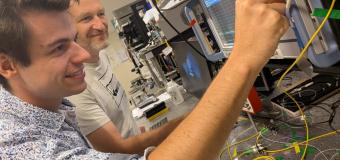
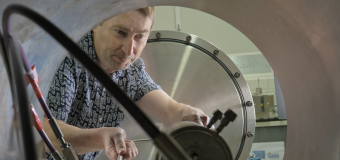
The "nanorobotics" team of FEMTO-ST institute has in fact developed a new microrobotics system that pushes forward the frontiers of optical nanotechnologies. Combining several existing technologies, the μRobotex platform builds microstructures in a large vacuum chamber and attaches components to optical fiber tips with nanoscale precision.

The construction of the micro-home (size: 20 * 10 * 15μm), reported in the "Journal of Vacuum Science and Technology A", shows how researchers can advance optical detection technologies when handling ion guns , electron beams and finely controlled robotic piloting.

Until now, lab-on fiber technologies did not have robot actuators for nano-assembly, which prevented engineers from building microstructures. This innovation makes possible to install miniaturized sensing elements on fiber tips so that engineers can see and manipulate different components.

With this advance, optical fibers as thin as human hair can be inserted into inaccessible places like jet engines and blood vessels to detect radiation levels or viral molecules.

By using this platform called "μrobotex"almost unique in the world, FEMTO-ST engineers are now building functionalized microstructures to detect specified molecules by attaching their microstructures to optical fibers.

The "nanorobotics" team hopes to push the frontiers of technology even further, by building smaller structures and fixing them on carbon nanotubes of only 20 nanometers to 100 nanometers in diameter.

Many media have highlighted this feat, which also received a tweet of congratulations from Frédérique Vidal, The French Minister of Higher Education and Research.

  • 3 tenure track position at FEMTO-ST

    In 3 of its strategic research priorities: micro-nanotechnologies, artificial intelligence and sustainable development.

    Read more
  • FEMTO-ST s'implique du 19 au 21 Mai à Pint of Science Festival

    De nombreux chercheurs de l’institut se mobilisent à Besançon et à Belfort  à l’occasion de la 11ème édition du festival international de vulgarisation scientifique sur des thématiques variées : optique, robotique, IA... Inscrivez-vous pour

    Read more
  • FEMTO-ST is launching its support program for MSCA Postdoctoral Fellowships applications !

    The Boostcamp is a two-day intensive workshop aimed at helping international researchers develop a strong application for the 2025 Marie Skłodowska-Curie Postdoctoral Fellowship.

    Read more
  • Using artificial intelligence to collect agricultural data

    ANR OCOD project combines intelligent sensors, drones and optimization for data collection in constrained natural environments

    Read more
  • A European project to prevent perineal tears

    PELVITRACK offers a predictive tool for patricians as part of an interdisciplinary European consortium involving FEMTO-ST.

    Read more
  • 12 postes d’enseignants-chercheurs à pourvoir à FEMTO-ST

    Informatique, Génie informatique - automatique et traitement du signal, Génie Civil - Physique et Energétique du bâtiment, mécanique – génie mécanique.

    Read more
  • Best Paper Award at BIOSTEC 2025

    The work of Ouassim Boukhennoufa and his team combines AI and image optimization in nuclear medicine for more accurate and earlier detection of parathyroid anomalies.

    Read more
  • Kagomé structures for quantum technologies

    Quantum technologies open up promising prospects, but require the development of new materials with remarkable properties.

    Read more
  • Launch of the European SAMI project for energy-free intelligent sensors

    A major scientific and technological collaboration between Silmach and FEMTO-ST in the field of intelligent, autonomous sensors kicks off on January 30.

    Read more
  • RENATECH 2024 PhD AWARD

    Adria Grabulosa is rewarded for his work on 3D printed circuits using an original two-photon optical additive manufacturing technique.

    Read more