
The institute
FEMTO's news

Développement d'un polymère thermodurcissable biosourcé et recyclable :

Une étape majeure vers l'intégration des composites à matrices thermodurcissables dans l'économie circulaire et biosourcée.

Les résines polyépoxydes thermodurcissables, communément appelées époxy, constituent une classe importante de matériaux polymères. Associées à des fibres de verre ou de carbone, elles trouvent depuis de nombreuses années leur utilisation dans la fabrication de composants d’avions, de trains, de bateaux et d’éoliennes. Ces polymères renforcés de fibres présentent d’excellentes propriétés mécaniques et thermiques, en plus d’être beaucoup plus légers que les métaux. Cependant, en raison de leur nature fortement réticulée, les époxys souffrent d'une incapacité à être recyclés, conduisant à un impact dévastateur sur l’environnement. Il existe ainsi un besoin évident de concevoir des résines époxys intrinsèquement recyclables basées sur des ressources renouvelables.

Cet article, paru dans « Science », présente la synthèse et le recyclage d'une résine époxy totalement biosourcée, résultant de la combinaison judicieuse de synthons dérivés de la cellulose et de la lignine, et dotée d'excellentes propriétés thermomécaniques (une température de transition vitreuse de 170°C et un module de stockage à 25°C de 1,2 GPa). Une simple méthanolyse réalisée en l’absence de tout catalyseur permet ensuite la récupération de tous les synthons biosourcés impliqués. Sa compatibilité avec des fibres de verre et des fibres végétales est également démontrée. Cela, associé à l'excellente stabilité dans une large gamme de solvants organiques et à son inertie démontrée vis-à-vis de l'hydrolyse, souligne le fort potentiel de ces époxys à base d'ester furanique dans des domaines d'application pertinents impliquant des transports durables, des revêtements, des peintures ou des dispositifs biomédicaux. Dans l'ensemble, ces résultats représentent une étape importante vers l'intégration des thermodurcissables dans l'économie circulaire et biosourcée.

Ce travail a été mené à l’initiative et sous l’impulsion du Professeure Katalin Barta de l’Université de Graz, en étroite collaboration avec l’Université de Groningen, l’Institut Charles Gerhardt Montpellier (Université de Montpellier, CNRS) et l’institut FEMTO-ST de Besançon (Université de Franche-Comté, CNRS). L’équipe Mat’éco (Matériaux pour la transition écologique de FEMTO-ST) a évalué la compatibilité de cette nouvelle époxy recyclable avec des fibres végétales pour la production de composites biosourcés.

https://doi.org/10.1126/science.adj9989

Voir l’actualité mise en avant par CNRS chimie

Contact : Vincent Placet
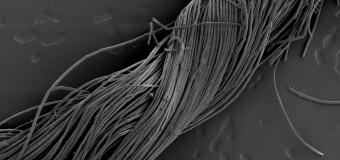
  • ThermoBot : micro robots that walk on water

    Imagine, a robot, the size of a fly, walking on the surface of the water and pursued by a laser beam. One could believe in a science fiction scenario...

    Read more
  • Recognizing liars from the sound of their voice ?

    Scientists have prouved that the intensity, speed and pitch of the speaker's voice automatically influences our perception of the reliability and honesty of his or her speech. This work is published in the prestigious journal "Nature Communications"

    Read more
  • European project for the development of sustainable and high-performance bio-based composites

    Led by FEMTO-ST and supported by the University of Franche-Comté, the « SSUCHY » R&D project which brings together 17 European partners is entering its final phase. The project is now quite advanced.

    Read more
  • Understanding the cytotoxicity of metallic nanoparticles

    A recent study published in the journal "Chemical Science" and involving FEMTO-ST gives new insights into the understanding of the mechanisms of DNA alteration in cells by metallic nanoparticles.

    Read more
  • Artificial intelligence for next-generation ultrafast photonics

    How can machine learning and associated methods improve the development of next-generation laser sources and revolutionize applications where ultrafast light plays a central role?

    Read more
  • Strong involvement of FEMTO-ST in the H2020 project "PhotonHub Europe"

    The objective of this project is to help European SMEs to increase their competitiveness through photonics with a online guidance, which will offer the support of 54 leading competence centers in Europe, including FEMTO-ST, which is also the scientific coordinator at the national level.

    Read more
  • First demonstration of self-confined nonlinear waves in plasmonic structures

    By providing the very first experimental evidence of the existence of this phenomenon, FEMTO-ST researchers and their partners hope to be able to generate this nonlinear effect using low intensity laser sources, in order to use it for nanophotonics applications.

    Read more
  • Mengjia Wang receives the « Chinese government award 2020 »

    As a PhD student of the Optics Department of FEMTO-ST , Mengjia Wang has been recognized by the Chinese Government for his outstanding work in the field of nanophotonics and plasmonics.

    Read more
  • Laurent LARGER named Fellow 2021 of OSA

    Full professor of Physics/Optics at the University of Franche-Comté and researcher at FEMTO-ST institute, Laurent Larger is rewarded for his pioneering work on nonlinear dynamics in optoelectronics and on the development of new architectures for photonic artificial intelligence.

    Read more
  • CNRS "Proof by Image" competition

     Discover the selection of the 20 images selected by the CNRS, one of which is presented by FEMTO-ST, and vote for the "audience award" photo.

    Read more