
The institute
FEMTO's news

National research program on miniature robotics

FEMTO-ST is leading the MINIRO project, which brings together a national academic consortium of excellence in miniature robotics.

Miniature robotics is booming and is now establishing itself as a major strategic lever for responding to major industrial, economic, and societal challenges. By launching the PEPR Robotics program, led by the CNRS, the French government has a clear objective: to remove scientific and technological barriers in order to build robotics that is powerful, frugal, and responsible.

The MINIRO (Miniature Robotics) project, coordinated by Marie and Louis Pasteur University (UMLP), is one of the projects under this PEPR (Priority Economic Research Program) as part of France 2030.

To promote their deployment, the project focuses on three key scientific challenges:

• improving the dexterity and reliability of miniature robots,

• optimizing energy and power transmission despite severe space constraints,

• ensuring high performance despite the significant influence of their environment...

Led by the FEMTO-ST Institute in collaboration with the ICube laboratory, the MINIRO project brings together a national academic consortium of excellence comprising the UMLP, the University of Strasbourg, the CEA, Sorbonne University, the CNRS, the University of Montpellier, IMT Atlantique, the University of Technology of Compiègne, SUPMICROTECH, Inserm, ENSTA, and Grenoble INP - UGA.
By combining their complementary scientific and technological expertise, these partners aim to demonstrate the full potential of miniature robotics in order to secure France's strategic position in a field that is experiencing rapid growth worldwide.

The goal is therefore to develop new technological building blocks based on innovative robotic architectures. This work will focus in particular on the design of submillimeter-sized robots with integrated actuation mechanisms, as well as the development of continuously deformable robots capable of interacting adaptively with their environment.

All of these technologies will be designed, integrated, and deployed in experimental demonstrators in order to validate their performance, robustness, and application potential.

The official launch of the project took place on February 3 and will run for 76 months, with a total budget of €8,924,156 (including €3,000,000 in funding from France 2030).

.The nine laboratories involved are: FEMTO-ST, ICube, CEA List, ISIR, Lab-STICC, LIRMM, LS2N, Laboratoire Roberval, and TIMC.

Contact : Cédric Clevy, Institut FEMTO-ST
 

  • Detecting problems of the anti-bleeding system of patients in 60 minutes

    Researchers from FEMTO-ST institue and the Universitiy of Geneva  have developed an innovative device that investigates a patient’s platelet capacity in near real-life conditions so that bleeding can be stopped.

    Read more
  • Focus on the european MiMédi project

    On Tuesday 11 June 2019, the teams of the FEMTO-ST Institute and the EFS Bourgogne-Franche-Comté will present, in the presence of representatives of the regional district, an important European research project on regional smart specialisation.  Bringing together 10 industrial and academic p

    Read more
  • Closure of the S3-4AlpClusters project

    The final conference of the S3-4AlpClusters project was held in Venice on the 13th and 14th of March, in attendance of all the partners (including FEMTO-ST), observers, policy makers and members of the European Commission.

    Read more
  • The W. G. Cady Prize awarded to Serge GALLIOU at the IEEE IFCS 2019

    This award recognizes Serge Galliou's exceptional and pioneering contributions in the development of cryogenic acoustic resonators with extremely high quality factors (very low mechanical losses) for sensor, oscillator or fundamental physics applications.

    Read more
  • FEMTO@SCHOOL : des chercheurs invitent la lumière dans les lycées

    Les opticiens de FEMTO-ST proposent un large éventail d'activités de vulgarisation autour de la lumière et de ses applications pour susciter l’intérêt des lycéens pour les sciences et les technologies. 

    Read more
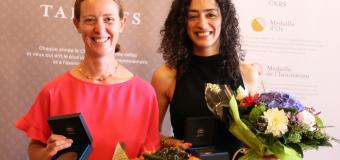
  • Two CNRS bronze medals for FEMTO-ST

    Aude Bolopion (biomedical micro-nano robotics) and Nadia Steiner (fuel cell diagnostics) are awarded with the CNRS 2019 bronze medal for their promising research.

    Each year, the CNRS bronze medals welcome some 40 young scientists whose career start is extremely promising

    Read more
  • Best student paper award for Rémi Meyer

    Remi Meyer got the best student presentation award at SPIE-Photonics West conference for his work on ultra-high aspect ratio Bessel beams. Shaping the beam of ultrafast lasers has become now an essential tool for ultra-high intensity laser-matter interaction.

    Read more
  • Visit of the CNRS President to FEMTO-ST

    Antoine Petit, CEO of the CNRS, was welcomed on February 11th at FEMTO-ST.


    Read more
  • Visite du Préfet du Doubs à FEMTO-ST

    Joël MATHURIN, nouveau Préfet du Doubs, est venu découvrir les activités de recherche de FEMTO-ST vendredi 25 janvier dernier.

    Read more
  • John Dudley awarded by the international Society of Optics and Photonics (SPIE)

    He obtains  the "SPIE Harold E. Edgerton" Award 2019 for pioneering applications based on ultra-short light pulses in optical fibers.

    Read more