
The institute
FEMTO's news

National research program on miniature robotics

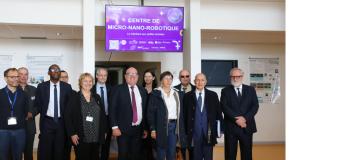
FEMTO-ST is leading the MINIRO project, which brings together a national academic consortium of excellence in miniature robotics.

Miniature robotics is booming and is now establishing itself as a major strategic lever for responding to major industrial, economic, and societal challenges. By launching the PEPR Robotics program, led by the CNRS, the French government has a clear objective: to remove scientific and technological barriers in order to build robotics that is powerful, frugal, and responsible.

The MINIRO (Miniature Robotics) project, coordinated by Marie and Louis Pasteur University (UMLP), is one of the projects under this PEPR (Priority Economic Research Program) as part of France 2030.

To promote their deployment, the project focuses on three key scientific challenges:

• improving the dexterity and reliability of miniature robots,

• optimizing energy and power transmission despite severe space constraints,

• ensuring high performance despite the significant influence of their environment...

Led by the FEMTO-ST Institute in collaboration with the ICube laboratory, the MINIRO project brings together a national academic consortium of excellence comprising the UMLP, the University of Strasbourg, the CEA, Sorbonne University, the CNRS, the University of Montpellier, IMT Atlantique, the University of Technology of Compiègne, SUPMICROTECH, Inserm, ENSTA, and Grenoble INP - UGA.
By combining their complementary scientific and technological expertise, these partners aim to demonstrate the full potential of miniature robotics in order to secure France's strategic position in a field that is experiencing rapid growth worldwide.

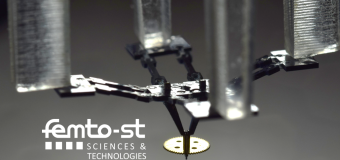
The goal is therefore to develop new technological building blocks based on innovative robotic architectures. This work will focus in particular on the design of submillimeter-sized robots with integrated actuation mechanisms, as well as the development of continuously deformable robots capable of interacting adaptively with their environment.

All of these technologies will be designed, integrated, and deployed in experimental demonstrators in order to validate their performance, robustness, and application potential.

The official launch of the project took place on February 3 and will run for 76 months, with a total budget of €8,924,156 (including €3,000,000 in funding from France 2030).

.The nine laboratories involved are: FEMTO-ST, ICube, CEA List, ISIR, Lab-STICC, LIRMM, LS2N, Laboratoire Roberval, and TIMC.

Contact : Cédric Clevy, Institut FEMTO-ST

 

  • The fastest pick-and-place robot in the world

    A research team has developed a miniature robot capable of manipulating micrometric objects at unprecedented speeds. This work has been published in the prestigious American journal "Science Robotics"

    Read more
  • Aude Bolopion receives the 2022 “Big-in-Small award”

    This yearly award, from the microrobotics international community in the MARSS conference in Toronto, promotes “the best microrobotician” of the year at the international level.

    Read more
  • Engins spatiaux : un lubrifiant solide adapté à l'air comme au vide

    les engins spatiaux sont soumis à des contraintes extrêmes. Des chercheurs ont développé un prototype de lubrifiant solide qui ne souffre pas de l’oxydation à l’air libre et qui fonctionne mieux que les solutions actuelles dans le vide. Ces travaux ont abouti à un dépôt de brevet.

    Read more
  • FEMTO-ST : 2 full professors appointed to the IUF in its class 2022

    Ausrine MARGUERON-BARTASYTE and Daniel HISSEL are among the 164  national laureates appointed to the Institut Universitaire de France (IUF) by the Minister of Higher Education and Research

    Read more
  • Tribute to our colleague Philippe LUTZ

    Our scientific community of Burgundy-Franche-Comté has just suddenly lost Philippe LUTZ, full professor at the University of Franche-Comté and a leading figure in microrobotics and micromechatronics research at the FEMTO-ST laboratory.

    Read more
  • How to create a chemical bond with light?

    The formation of a chemical bond between two molecules often requires an activation process. Light is a stimulus that is particularly interesting

    Read more
  • Best student paper Award for Clément Carlé at the international conférence IFCS-EFTF2022

    This award was obtained in the "Microwave Frequency Standards" category of this major international conference in the field of time-frequency metrology, which took place in Paris from 24 to 28 April 2022.

    Read more
  • Daniel BRUNNER winner of an ERC Consolidator grant 2021

    Daniel BRUNNER is a CNRS researcher at the FEMTO-ST Institute and has been awarded a prestigious European Research Council Cosolidator Grant of 2M € for his INSPIRE project

    Read more
  • La formation CMI H3E mise à l’honneur

    Porté par Nadia Yousfi Steiner, le CMI H3E vient d’être récompensé par le trophée Hydrogénies pour la catégorie "Prix de la sensibilisation, de l’Education et de la Formation"

    Read more
  • Daniel HISSEL awarded as « Fellow » of the IEEE society

    Professor in Electrical Engineering at the University of Franche-Comté and researcher at FEMTO-ST, Daniel Hissel has been awarded as  for his work on hydrogen systems.

    Read more