
The institute
FEMTO's news

Fiber optic sensors: a technological leap thanks to quantum photon counting

Researchers at FEMTO-ST have extended the range of fiber-optic temperature sensors to 150 kilometers, using photonic detection technology derived from quantum physics.

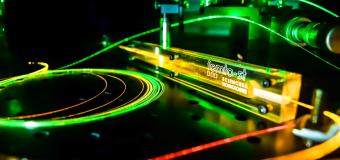
Real-time monitoring of energy networks, particularly offshore wind farms, increasingly relies on distributed fiber optic temperature sensors. These sensors use a pulsed laser injected into an optical fiber, causing temperature-related backscattering of light through a phenomenon known as Brillouin scattering. By analyzing the frequency variations of this scattered light, it is possible to map the temperature along the entire length of the optical fiber.

However, this technology has until now come up against a range limit, generally set at 80 km for commercial systems, due to optical losses and electronic noise in the detectors.

Recent work carried out at FEMTO-ST in collaboration with the Swiss company Omnisens (Prysmian Group) has made it possible to extend this limit to 150 km without intermediate optical amplification. This was achieved by using Single Photon Avalanche Detectors (SPAD), capable of counting photons with extremely low noise. By combining this technology with optimized measurement time, the researchers achieved a spatial resolution of 20 meters over the entire distance, in just one hour of measurement.

An analytical model developed from these experiments suggests that the range could be further extended to 200 km, which would be a new world record for this type of sensor.

This technological breakthrough, achieved as part of Maxime Romanet's thesis, is part of the cross-border INTERREG VI DISTANCE project, which brings together several Franco-Swiss players in photonics and energy monitoring. It also opens up promising prospects for other fields requiring high sensitivity, such as lidar systems and scientific imaging.

This work was published last February in the journal OPTICA : https://doi.org/10.1364/OPTICA.549392

Contact at FEMTO-ST : Jean-Charles BEUGNOT
 

  • Webconférences sur "e.Micronora"

    Dans le cadre de l’évènement virtuel sur les microtechniques « e.Micronora », FEMTO-ST propose des conférences en ligne le jeudi 24 septembre  au matin.

    Read more
  • Imaging quantum interference of entangled photon pairs of extremely high dimensionality

    Researchers from the Optics Department have developed an imaging device allowing the spatial and temporal resolution of the phenomenon of quantum interference between pairs of entangled photons of extremely high dimensionality.

    Read more
  • Concours posters doctorants : 11 ambassadeurs récompensés

    11 doctorants de 1ère année mis à l’honneur lors de l’Assemblée générale de FEMTO-ST du 10 juillet.

    Read more
  • Fei GAO Receives IEEE J.D. Irwin Early Career Award

    As a member of the SHARPAC team and Deputy Director of FEMTO-ST, Fei Gao has been recognized by the IEEE IES Society for his outstanding work in improving the reliability of hydrogen electric powertrains.

    Read more
  • Daniel HISSEL, winner of the CNRS 2020 Innovation Medal

    Full professor at the University of Franche-Comté, researcher at FEMTO-ST Institute and co-founder of a start-up on efficient hydrogen fuel cells, Daniel HISSEL is one of the four national winners of the CNRS 2020 Innovation Medal.

    Read more
  • A new source of infrared light thanks to fibre optic cascades

    Scientists from  FEMTO-ST Institute and McGill University (Montreal, Canada) have designed and developed in collaboration with three French companies a light source covering the entire mid-infrared wavelength range: from 2 to 10 µm.

    Read more
  • Topological crystals to guide waves on the water surface

    Topological crystals have the property of being conductive on their surface, but insulating in their volume which allows very efficient wave guidance by engineering the structure of these materials, generally arranged in a hexagonal symmetry, inspired by the graphene.

    Read more
  • Hommage à Raymond BESSON, « l’homme du quartz à 10-14 »

    Scientifique passionné, professeur à l’ENSMM jusqu’en 2006 et directeur du Laboratoire de Chronométrie, Electronique et Piézoélectricité entre 1978 et 2002, Raymond Besson était réputé dans la communauté internationale du temps-fréquence pour ses résonateurs à quartz et est décédé ce 15 avril.

    Read more
  • Des visières de protection produites en série

    Dans le cadre de la crise sanitaire actuelle, FEMTO-ST, en lien avec ses tutelles, s'est impliqué dans la réalisation de deux modèles de visières de protection qui sont produites en série sur le site bisontin depuis le 9 avril 2020.

    Read more
  • An innovative solution to detect pollutants in the subsoil

    Researchers from FEMTO-STinstitute and the company TOTAL SA have succeeded in detecting organic pollutants with methods that did not require sampling and have been able to monitor the evolution of the pollution of the subsoil over periods ranging up to several years.

    Read more